
Apantesis carlotta
Ferguson, 1985
Carlotta's tiger moth, Charlotte's Tiger Moth
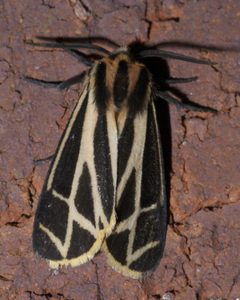
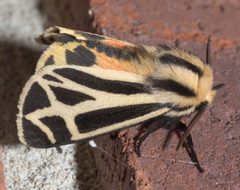
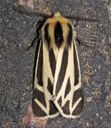
Apantesis carlotta is a tiger moth in the Erebidae, described by Douglas C. Ferguson in 1985. The occurs across eastern and central North America, from Maine to Georgia and westward to North Dakota and Texas. have a wingspan of approximately 30 mm. The species has been documented outside its native range in Baghdad, Iraq, where specimens were collected from mulberry trees and clover plants.
Pronunciation
How to pronounce Apantesis carlotta: //əˈpæn.tɪ.sɪs kɑrˈlɒt.tə//
These audio files are automatically generated. While they are not always 100% accurate, they are a good starting point.
Images
Distribution
Native to North America: found from Maine to Georgia, west to North Dakota and Texas. Documented in Baghdad, Iraq, where specimens were collected from mulberry trees and clover plants using fluorescent lights at night.
Host Associations
- Lactuca - larval larvae have been reared on Lactuca
Behavior
; attracted to fluorescent lights at night.
Similar Taxa
- Apantesis proximaFormerly placed in the same ; both share tiger moth characteristics with striped forewings
- Grammia speciesHistorical taxonomic confusion; Apantesis were formerly placed in Grammia
More Details
Taxonomic history
The Apantesis has undergone taxonomic revision, with formerly placed in Grammia and Notarctia. Apantesis carlotta was described relatively recently in 1985, making it one of the more recently recognized species in this group.
Collection methods
Specimens in Iraq were collected using air nets and fluorescent lights at night, preserved in 70% ethyl acetate.
Morphological study
A 2023-2024 study in Iraq documented external morphological characteristics, with particular attention to reproductive organ features as distinguishing traits from other .
Sources and further reading
- BugGuide
- Wikipedia
- GBIF taxonomy match
- iNaturalist taxon
- NCBI Taxonomy
- Catalogue of Life
- Bug Eric: National Moth Week 2021 Review
- Bug Eric: Remembering National Moth Week 2018
- Sphingidae | Beetles In The Bush | Page 2
- Bug Eric: October 2018
- The Moth and Me | Beetles In The Bush
- Saturniidae | Beetles In The Bush | Page 2
- External Morphological Study of Apantesis Carlotta Ferguson, 1985 Arctiidae-Lepidoptera-Insect in Baghdad, IRAQ