
Carmenta
Edwards, 1881
clearwing moth
Species Guides
32- Carmenta albociliata
- Carmenta anthracipennis(liatris borer moth)
- Carmenta apache
- Carmenta arizonae
- Carmenta armasata
- Carmenta auritincta(Arizona Clearwing Moth)
- Carmenta bassiformis(Ironweed Clearwing Moth)
- Carmenta corni(aster borer moth)
- Carmenta engelhardti
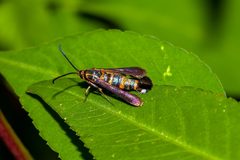
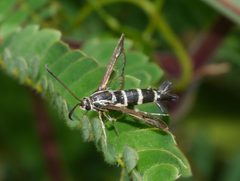
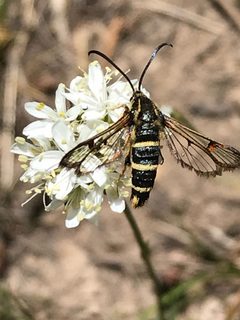
Carmenta is a of clearwing moths in the Sesiidae, characterized by transparent or partially transparent wings resulting from reduced wing scaling. The genus contains approximately 100 described distributed primarily in the Neotropics, with some species extending into North America. Members are and often -mimicking in appearance. Several species are economically significant as pests of agricultural crops, including C. theobromae which has shifted from native cacao to become a major pest of guava in Colombia.
Pronunciation
How to pronounce Carmenta: //karˈmɛn.ta//
These audio files are automatically generated. While they are not always 100% accurate, they are a good starting point.
Identification
Clearwing moths in this can be distinguished from other Sesiidae by the combination of transparent wings with dark borders, reduced wing venation, and often -like coloration with yellow and black patterning. Specific identification requires examination of genitalia and wing venation patterns; only about half of described species have been barcoded.
Images
Habitat
Tropical and subtropical forests; agricultural orchards for pest . The type locality for C. brachyclados was tropical jungle in Guyana. C. theobromae occurs inside guava trees at altitudes around 1575 m in Colombia.
Distribution
Primarily Neotropical, ranging from Central America through South America. C. brachyclados described from Guyana. C. theobromae reported from Trinidad (type locality), Venezuela, and Colombia. C. wildishorum recorded from New Mexico and Colorado (USA).
Host Associations
- Mora excelsa - larval seed pod for C. brachyclados
- Psidium guajava (guava) - larval stem-boring for C. theobromae in Colombia
- Theobroma cacao (cacao) - original larval original for C. theobromae, fruits/seeds and stems
Behavior
are day-flying. Larvae of some are stem-borers, forming characteristic ring-shaped scars around plant stems by removing bark to reach vascular cambium.
Human Relevance
C. theobromae is a significant agricultural pest in Colombia, with 98% across 124 surveyed guava farms. The was accidentally introduced to Wales in 2024 via plant material in luggage, resulting in the first description of C. brachyclados based on specimens emerging indoors in Port Talbot.
Similar Taxa
- SynanthedonAlso clearwing moths in Sesiidae; distinguished by genitalia and wing venation patterns
- Dion (formerly Carmenta)Formerly included in Carmenta; now separated as distinct of (Hesperiidae)
Sources and further reading
- BugGuide
- Wikipedia
- GBIF taxonomy match
- iNaturalist taxon
- NCBI Taxonomy
- Catalogue of Life
- New species of clearwing moth from Guyana discovered in Wales
- Bug Eric: Results of the Red Rock Canyon Open Space Bioblitz
- Carmenta theobromae ( ), pest of guava in Colombia: biology, life cycle and natural enemies
- Pupal Development, Longevity and Behavior ofCarmenta theobromae(Lepidoptera: Sesiidae)
- The Natural History, Immature Stages, and Shelter Building Behavior ofDion carmenta(Lepidoptera: Hesperiidae: Hesperiinae) in Eastern Ecuador