
Synanthedon
Hübner, [1819]
clearwing moths
Species Guides
40- Synanthedon acerni(Maple Callus Borer)
- Synanthedon acerrubri(Maple Clearwing Moth)
- Synanthedon albicornis(Western Willow Clearwing Moth)
- Synanthedon alleri
- Synanthedon arizonensis(Arizona Clearwing Moth)
- Synanthedon arkansasensis(Arkansas Clearwing Moth)
- Synanthedon bibionipennis(Strawberry Crown Moth)
- Synanthedon bolteri(Northern Willow Clearwing Moth)
- Synanthedon canadensis(Canadian clearwing)
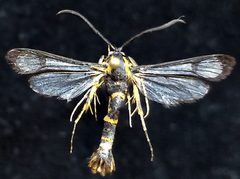
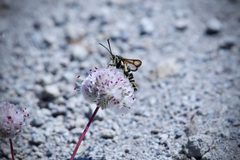
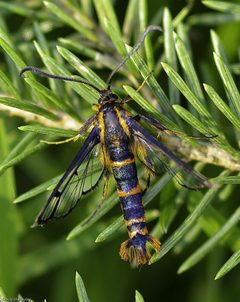
Synanthedon is a of clearwing moths ( Sesiidae) containing numerous distributed across the Northern Hemisphere. exhibit of or bees, with transparent or partially scaled wings, narrow bodies, and often wasp-like coloration. Larvae are internal borers in woody plants, with most species specializing on particular trees or shrubs. Several species are economically significant pests of fruit trees, ornamentals, and forest trees. The genus is characterized by adult activity and -mediated mate location.
Pronunciation
How to pronounce Synanthedon: /sɪˈnænθɪˌdɒn/
These audio files are automatically generated. While they are not always 100% accurate, they are a good starting point.
Identification
Members of Synanthedon can be distinguished from other sesiid by combinations of wing venation, genitalia , and associations. Most have partially or largely transparent forewings and hindwings with reduced scaling. often display yellow and black or dark color patterns mimicking hymenopterans. are frequently bipectinate in males and simpler in females. Specific identification typically requires examination of genitalia or use of species-specific lures.
Images
Habitat
Associated with woody plants across diverse environments including forests, orchards, urban landscapes, and riparian areas. Larvae inhabit living trees and shrubs, tunneling under bark or in stems.
Distribution
Widespread in the Northern Hemisphere with records from North America, Europe, and Asia. Specific distribution varies by ; some have restricted ranges while others are broadly distributed.
Seasonality
periods vary by and latitude, generally occurring during warmer months. Some species show distinct seasonal peaks detectable through trap monitoring.
Life Cycle
Larvae are internal borers in woody plants, tunneling under bark or in stems and roots. Developmental timing varies by and climate. typically occurs within the larval gallery. are short-lived and do not feed.
Behavior
are and generally not attracted to light traps. Males locate females using ; several have been documented responding to synthetic blends in field studies. Adults are swift, -like fliers. Some species have been observed at blacklights, though this appears exceptional rather than typical.
Ecological Role
Larvae act as primary consumers of living woody plant tissue. Some function as pests in managed . mimicry of stinging hymenopterans likely provides protection from .
Human Relevance
Several are economically damaging pests of cultivated plants. Synanthedon scitula (dogwood borer) attacks flowering dogwood and apple rootstocks. Synanthedon nashivora damages Asian pear orchards in Japan. -based monitoring and management programs have been developed for pest species.
Similar Taxa
- EuhagenaAnother sesiid with clearwing and -like appearance; distinguished by genitalia and associations
- MelittiaSesiid with more spectacular coloration and different wing patterns; often larger with more extensive scaling
- PennisettiaSesiid including raspberry cane borer; similar borer lifestyle but distinct and preferences
Sources and further reading
- BugGuide
- Wikipedia
- GBIF taxonomy match
- iNaturalist taxon
- NCBI Taxonomy
- Catalogue of Life
- Euhagena nebraskae… again | Beetles In The Bush
- A NEW DATA ON BIOLOGY OF SYNANTHEDON BICINGULATUM (STAUDINGER, 1887) (LEPIDOPTERA, SESIIDAE)
- Sex Attractant of a Clearwing Moth Synanthedon Nashivora (Lepidoptera: Sesiidae)
- Dogwood Borer, Synanthedon scitula (Harris) (Insecta: Lepidoptera: Sesiidae)
- A Note on the Biology of Synanthedon sapygaeformis floridensis (Grote) (Lepidoptera: Aegeriidae)
- The genome sequence of the Red-tipped Clearwing, Synanthedon formicaeformis (Esper, 1783).
- Complete mitochondrial genome of the clearwing moth Synanthedon namdoelegans Kim, Kim and Choi, 2025 (Lepidoptera: Sesiidae).
- The genome sequence of the White-barred Clearwing, Synanthedon spheciformis (Denis & Schiffermüller), 1775 (Lepidoptera: Sesiidae).