
Synanthedon acerrubri
Engelhardt, 1925
Maple Clearwing Moth, Red Maple Borer
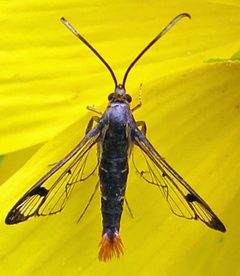
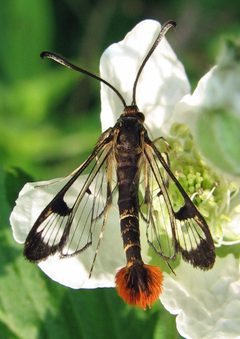
Synanthedon acerrubri is a clearwing moth in the Sesiidae, commonly known as the maple clearwing moth or red maple borer. The is a wood-boring pest of maple trees in eastern North America. are and -mimicking in appearance, with transparent wings and banded . Larvae tunnel into the trunks and branches of trees, causing structural damage.
Pronunciation
How to pronounce Synanthedon acerrubri: /sɪˈnænθɛdɒn əˌsɛrwəˈbriː/
These audio files are automatically generated. While they are not always 100% accurate, they are a good starting point.
Identification
resemble or due to transparent wings with dark margins, narrow wasp-waisted body, and often yellow or orange banding on a dark . The combination of clear wings with reduced scaling, wasp-like , and activity distinguishes Sesiidae from most other . Specific identification to S. acerrubri requires examination of genitalia or association with plant; adults are similar to other Synanthedon and other clearwing borers.
Images
Habitat
Associated with maple-dominated forests and urban or suburban areas where maple trees (Acer spp.) are present. Larvae develop within living maple trees, particularly in trunks and branches.
Distribution
Eastern United States and eastern Canada. Records include Vermont and broader eastern Nearctic region.
Diet
Larvae bore into and feed on the wood of several maple (Acer spp.), with particular association with red maple (Acer rubrum) and sugar maple (Acer saccharum).
Host Associations
- Acer rubrum - larval primary , red maple
- Acer saccharum - larval sugar maple
Life Cycle
Wood-boring larvae tunnel into living maple trees, feeding on inner bark and sapwood. Development occurs within tree tissue. are and active during daylight hours. Specific details on location, number of per year, and adult timing are not documented in available sources.
Behavior
are and exhibit -mimicry in both appearance and . They are generally not attracted to light traps, making detection and collection difficult without lures. Adults have been observed at blacklights on occasion, though this appears inconsistent.
Ecological Role
As a primary wood-borer of living maple trees, larvae contribute to tree stress and mortality in forest and urban . The functions as a pest in managed landscapes and commercial maple syrup operations.
Human Relevance
Considered a significant pest of maple trees, capable of causing substantial damage to red maple and sugar maple. affect ornamental plantings, forest health, and commercial maple syrup production. Detection is challenging due to cryptic larval habit and activity; -based monitoring has been used for survey and detection.
Similar Taxa
- Synanthedon acerniAlso a maple borer with similar range and appearance; requires genitalia examination for reliable separation
- Synanthedon scitulaAnother clearwing borer with overlapping distribution and -mimicking appearance; distinguished by association and morphological details
- Other SesiidaeMany clearwing moths share transparent wings and -like form; identification relies on plant association, geographic range, and detailed morphological study