
Synanthedon acerni
(Clemens, 1860)
Maple Callus Borer, Maple Callus Borer Moth
Synanthedon acerni, the maple callus borer, is a clearwing moth in the Sesiidae. are active primarily during late spring and early summer, with periods varying by latitude. The is associated with maple trees, where larvae develop as borers in tissue.
Pronunciation
How to pronounce Synanthedon acerni: //sɪˈnænθɪˌdɒn əˈsɜːrnaɪ//
These audio files are automatically generated. While they are not always 100% accurate, they are a good starting point.
Identification
Distinguished from other clearwing moths by association with Acer , timing of (April–July depending on region), and geographic distribution in eastern North America. Similar such as Synanthedon scitula (dogwood borer) and other Synanthedon spp. require examination of genitalia or host association for definitive identification. The maple callus borer specifically targets callus tissue at wound sites on maples, a habit not shared by all .
Images
Appearance
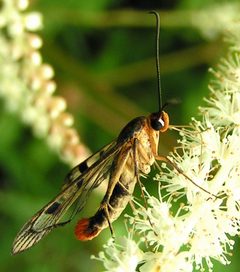
Wingspan 18–25 mm. Forewings narrow and elongate, partially transparent with dark scaling along and margins. Hindwings more extensively clear with reduced scaling. Body slender, -mimicking in general form. typically with pale banding. to weakly bipectinate.
Habitat
Deciduous forests, woodlots, and urban or suburban areas where maple trees (Acer spp.) are present. Larval is within living maple tissue, particularly at wound sites where callus tissue forms.
Distribution
Eastern Canada and much of the Eastern United States. Records include Vermont and other northeastern states, with range extending westward through the Midwest.
Seasonality
on wing from April through July, with peak activity in June to July in northern portions of the range and earlier (April onwards) in southern areas.
Diet
Larvae feed on Acer , specifically boring into callus tissue formed at wound sites on maple trees. feeding habits unknown.
Host Associations
- Acer - larval larvae bore into callus tissue at wound sites
Life Cycle
Larval development occurs within living maple tissue, with feeding restricted to callus tissue formed at wound sites. presumably occurs in or near the larval gallery. emerge in spring to early summer. Specific details of placement and stage not documented in available sources.
Behavior
have been observed at blacklight traps, though many Sesiidae are and not strongly attracted to lights. period is relatively brief and tied to spring-early summer. Specific mating or oviposition not described.
Ecological Role
Larvae function as borers in living maple tissue, potentially affecting tree health through feeding on wound callus. May contribute to nutrient cycling through wood-boring activity, though impacts are generally minor on healthy trees.
Human Relevance
Occasional pest of ornamental and native maple trees due to larval boring activity. Not considered a major economic pest. Attracted to blacklights, making it accessible for observation and study.
Similar Taxa
- Synanthedon scitulaSimilar clearwing moth with overlapping eastern North American distribution; distinguished by association (Cornus spp. vs. Acer) and subtle morphological differences requiring close examination
- Other Synanthedon speciesNumerous share general clearwing moth ; definitive identification often requires examination of plant, geographic range, and genitalia
More Details
Light Attraction
Unlike many Sesiidae that are strictly and unresponsive to light traps, S. acerni has been documented at blacklights on multiple occasions, making it somewhat more frequently encountered than related .