
Synanthedonini
Niculescu, 1964
clearwing moths
Genus Guides
9- Alcathoe
- Carmenta(clearwing moth)
- Chamaesphecia
- Hymenoclea
- Palmia
- Penstemonia
- Podosesia(Ash and Lilac Borer Moths)
- Sannina
- Synanthedon(clearwing moths)
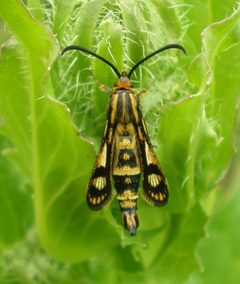
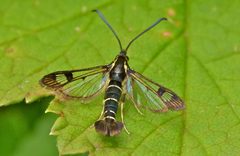
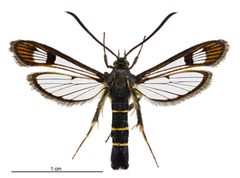
Synanthedonini is a tribe of clearwing moths within the Sesiidae, characterized by -mimicking appearance and larval boring habits in plant tissues. Members exhibit diverse plant associations across multiple families including Lauraceae, Fagaceae, Rosaceae, Fabaceae, and Proteaceae. The tribe has been documented across North America, Central and South America, Taiwan, and other regions, with several recognized as economically significant pests of ornamental and native plants. Molecular studies using COI barcoding support species-level identification but reveal phylogenetic complexities, including the atypical placement of some previously separated based on .
Pronunciation
How to pronounce Synanthedonini: /sɪnænˈθɛdoʊnaɪni/
These audio files are automatically generated. While they are not always 100% accurate, they are a good starting point.
Identification
distinguished from other Sesiidae by combination of morphological characters including wing venation patterns and genitalia structure; specific diagnostic features vary by . Synanthedon rileyana exhibits atypical and molecular placement compared to other Synanthedon . Carmenta brachyclados characterized by short hindwing (brachyclados = short branch). Accurate identification often requires examination of genitalia and/or , particularly for larval stages found in plant tissues. COI sequences provide unique genetic signatures for species-level identification across all life stages.
Images
Habitat
Forest and woodland ; specific microhabitats include tree trunks, branches, bark cracks, burls, and seed pods. In Taiwan, found in association with camphor trees, acorn-bearing oaks, and flowering cherries. Neotropical species associated with tropical jungle environments including leguminous trees such as Mora excelsa.
Distribution
Documented from North America, Central America, South America (including Guyana), Taiwan, and introduced (e.g., Carmenta mimosa in Australia). Specific documented localities include: Taiwan (Hualien, New Taipei City, Nantou, Taoyuan), northeastern New Mexico (Cimarron Mountain Range), and Guyana (Turtle Mountains, Iwokrama Forest).
Diet
Larvae feed internally in plant tissues: on callus tissue around bore holes covered with silk, debris, and ; in trunk burls; in bark cracks; in seed pods; and rarely in acorns. Documented larval include: Cinnamomum camphora (Lauraceae), Helicia formosana (Proteaceae), Prunus campanulata (Rosaceae), Mora excelsa (Fabaceae), and multiple Fagaceae . feed on nectar from flowers including Ampelopsis brevipedunculata (Vitaceae).
Host Associations
- Cinnamomum camphora - larval Larvae feed in trunk burls; Lauraceae
- Helicia formosana - larval Larvae feed in callus tissue; Proteaceae
- Prunus campanulata - larval Larvae feed in callus tissue; Rosaceae
- Mora excelsa - larval Larvae feed in seed pods; Fabaceae: Caesalpinioideae
- Fagaceae - larval Multiple feed on callus tissue of stems; one species is obligatory borer in acorns
- Ampelopsis brevipedunculata - nectar sourceVitaceae
Life Cycle
Females lay in bark cracks or appropriate plant tissues. Larvae bore into host plant tissues and feed internally, covering feeding holes with silk, debris, and . occurs within host plant or in soil. are . Under artificial conditions, larvae have been successfully reared on modified artificial diet incorporating host plant wood powder.
Behavior
exhibit Hymenoptera mimicry (-mimicking appearance and ). activity pattern with nectar feeding at flowers. Larval feeding behavior includes covering bore holes with silk, debris, and . Acorn-boring behavior in one represents a rare feeding strategy among clearwing moths.
Ecological Role
Human Relevance
Several cause detrimental economic and aesthetic impacts to commercially important ornamental and native plant species. Non-native pest introductions (e.g., Synanthedon myopaeformis) have reinforced need for molecular diagnostic tools for identification. Some species used as agents. Rare documentation of accidental transport by humans: Carmenta brachyclados individuals survived transport from Guyana to Wales in boot bag, emerging over three months later in winter conditions.
Similar Taxa
- Other Sesiidae tribesSynanthedonini distinguished by specific morphological characters including wing venation and genitalia; molecular reveals some traditionally recognized (Sannina, Podosesia) nest within Synanthedon clade, conflicting with prior morphological classifications
More Details
Phylogenetic complexity
Molecular studies reveal that Sannina uroceriformis and Podosesia are nested deeply within a well-supported clade of Synanthedon , conflicting with results from previous morphological studies. Synanthedon rileyana shows atypical placement, pairing with Carmenta bassiformis rather than with other Synanthedon species.
Taxonomic discovery
Recent descriptions include six new from Taiwan (2015) and Carmenta brachyclados from Guyana (2024), the latter described from specimens that emerged indoors in Wales after accidental transport. Only approximately half of the 100 described Carmenta species have been barcoded, suggesting substantial undiscovered diversity.
Sources and further reading
- BugGuide
- iNaturalist taxon
- NCBI Taxonomy
- Catalogue of Life
- New species of clearwing moth from Guyana discovered in Wales
- Molecular Identification of Synanthedonini Members (Lepidoptera: Sesiidae) using Cytochrome Oxidase I
- Two new species of the tribe Synanthedonini (Lepidoptera, Sesiidae), with new hostplant associations from Taiwan
- A review of clearwing moths in the tribe Synanthedonini, with descriptions of six new species from Taiwan (Lepidoptera: Sesiidae)
- A success for community science: Carmenta brachyclados sp. nov. (Lepidoptera, Sesiidae, Synanthedonini), a clearwing moth from Guyana discovered with its hostplant indoors in Wales (United Kingdom)
- Recognition of a new species of Carmenta from New Mexico supported by <br />morphology and mitochondrial cytochrome oxidase I data (Lepidoptera: Sesiidae: Sesiinae: Synanthedonini)
- Figures 1-4 from: Liang J-Y, Hsu Y-F (2019) Two new species of the tribe Synanthedonini (Lepidoptera, Sesiidae), with new hostplant associations from Taiwan. ZooKeys 861: 81-90. https://doi.org/10.3897/zookeys.861.34387
- Figures 9-12 from: Liang J-Y, Hsu Y-F (2019) Two new species of the tribe Synanthedonini (Lepidoptera, Sesiidae), with new hostplant associations from Taiwan. ZooKeys 861: 81-90. https://doi.org/10.3897/zookeys.861.34387
- Figures 5- 6 from: Liang J-Y, Hsu Y-F (2019) Two new species of the tribe Synanthedonini (Lepidoptera, Sesiidae), with new hostplant associations from Taiwan. ZooKeys 861: 81-90. https://doi.org/10.3897/zookeys.861.34387
- Figures 7- 8 from: Liang J-Y, Hsu Y-F (2019) Two new species of the tribe Synanthedonini (Lepidoptera, Sesiidae), with new hostplant associations from Taiwan. ZooKeys 861: 81-90. https://doi.org/10.3897/zookeys.861.34387
- Supplementary material 1 from: Sterling MJ, Cadet DT, Beasley J, Lees DC (2024) A success for community science: Carmenta brachyclados sp. nov. (Lepidoptera, Sesiidae, Synanthedonini), a clearwing moth from Guyana discovered with its hostplant indoors in Wales (United Kingdom). Nota Lepidopterologica 47: 201-218. https://doi.org/10.3897/nl.47.130138
- Supplementary material 2 from: Sterling MJ, Cadet DT, Beasley J, Lees DC (2024) A success for community science: Carmenta brachyclados sp. nov. (Lepidoptera, Sesiidae, Synanthedonini), a clearwing moth from Guyana discovered with its hostplant indoors in Wales (United Kingdom). Nota Lepidopterologica 47: 201-218. https://doi.org/10.3897/nl.47.130138
- Figures 1-6 from: Sterling MJ, Cadet DT, Beasley J, Lees DC (2024) A success for community science: Carmenta brachyclados sp. nov. (Lepidoptera, Sesiidae, Synanthedonini), a clearwing moth from Guyana discovered with its hostplant indoors in Wales (United Kingdom). Nota Lepidopterologica 47: 201-218. https://doi.org/10.3897/nl.47.130138
- Figure 17 from: Sterling MJ, Cadet DT, Beasley J, Lees DC (2024) A success for community science: Carmenta brachyclados sp. nov. (Lepidoptera, Sesiidae, Synanthedonini), a clearwing moth from Guyana discovered with its hostplant indoors in Wales (United Kingdom). Nota Lepidopterologica 47: 201-218. https://doi.org/10.3897/nl.47.130138
- Figures 11-16 from: Sterling MJ, Cadet DT, Beasley J, Lees DC (2024) A success for community science: Carmenta brachyclados sp. nov. (Lepidoptera, Sesiidae, Synanthedonini), a clearwing moth from Guyana discovered with its hostplant indoors in Wales (United Kingdom). Nota Lepidopterologica 47: 201-218. https://doi.org/10.3897/nl.47.130138
- Figure 10 from: Sterling MJ, Cadet DT, Beasley J, Lees DC (2024) A success for community science: Carmenta brachyclados sp. nov. (Lepidoptera, Sesiidae, Synanthedonini), a clearwing moth from Guyana discovered with its hostplant indoors in Wales (United Kingdom). Nota Lepidopterologica 47: 201-218. https://doi.org/10.3897/nl.47.130138