
Carmenta bassiformis
(Walker, 1856)
Ironweed Clearwing Moth, Eupatorium Borer Moth
Carmenta bassiformis is a clearwing moth in the Sesiidae, first described by Francis Walker in 1856. It is native to the eastern and central United States, where are active from late spring through early autumn. The is notable for its transparent wings and -mimicking appearance, a common trait among sesiid . Larvae develop as root borers in specific plants.
Pronunciation
How to pronounce Carmenta bassiformis: //kɑːrˈmɛntə bəˈsɪfɔːrmɪs//
These audio files are automatically generated. While they are not always 100% accurate, they are a good starting point.
Identification
Distinguished from other clearwing moths by combination of size, geographic range, and plant association. The transparent wings with dark borders separate it from fully scaled . Within Carmenta, identification to level requires examination of genitalia or association with known larval hosts (ironweed or Joe-Pye weed). Similar sesiid species in range may be distinguished by wing venation patterns and abdominal banding.
Images
Appearance
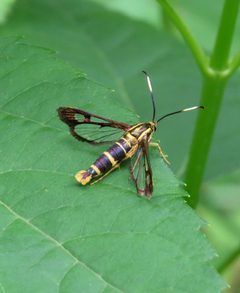
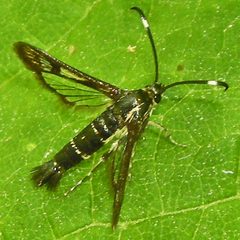
have transparent, scaleless wings with dark borders and , giving a clearwing appearance. The wingspan measures 18–26 mm. The body is slender and -like, with yellow and black or dark coloration typical of clearwing moths. Wings lack the dense scaling seen in most , with only the wing borders, veins, and body retaining pigmented .
Habitat
Occurs in open including meadows, prairies, and disturbed areas where plants grow. Associated with moist to mesic environments supporting stands of ironweed (Vernonia) and Joe-Pye weed (Eutrochium).
Distribution
United States: Massachusetts to Florida, west to Wisconsin, Kansas, and Texas. Records concentrated in eastern deciduous forest and central prairie regions.
Seasonality
active from late May through September. Single or possibly overlapping with peak activity in mid-summer.
Diet
Larvae feed on roots of ironweed (Vernonia spp.) and Joe-Pye weed (Eutrochium spp.). feeding habits not documented.
Host Associations
- Vernonia - larval ironweed
- Eutrochium - larval Joe-Pye weed
Life Cycle
Larvae are root borers, feeding internally on plant roots. occurs in soil or within root material. emerge in late spring and summer. Specific details of placement and larval instars not documented.
Behavior
are and , active during daylight hours and at dusk. -mimicking and appearance likely serves as anti- defense. Attracted to flowers for nectar, though this has not been specifically documented for this .
Ecological Role
Larvae act as root herbivores on native plants, potentially influencing plant . may contribute to pollination, though this role is unstudied. Serves as prey for insectivorous birds and other .
Human Relevance
No documented economic importance. Occasionally encountered by gardeners and naturalists in native plant gardens. Not considered a pest .
Similar Taxa
- Other Carmenta speciesMany Carmenta clearwings share transparent wings and -like appearance; require genitalia examination or association for definitive identification
- Sesiidae family membersOther clearwing moths in range share general ; distinguished by specific wing patterns, body coloration, and size
More Details
Nomenclature
Originally described as Aegeria bassiformis by Walker in 1856, later transferred to Carmenta.