
Sannina uroceriformis
Walker, 1856
Persimmon Borer Moth, persimmon borer
Sannina uroceriformis, commonly known as the persimmon borer , is a clearwing moth in the Sesiidae. It is native to the eastern and central United States. The exhibits in size, with females slightly larger than males. The references its larval association with persimmon trees.
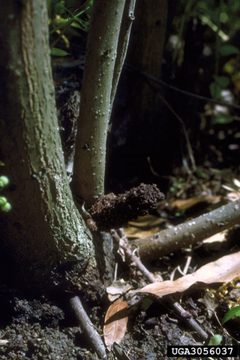
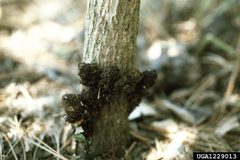
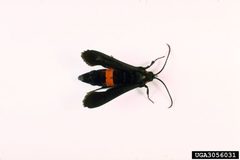
Pronunciation
How to pronounce Sannina uroceriformis: /sænˈnaɪnə ʊˌroʊsɛrɪˈfɔrmɪs/
These audio files are automatically generated. While they are not always 100% accurate, they are a good starting point.
Identification
The combination of small size (28–32 mm wingspan), eastern and central US distribution, and association with persimmon distinguishes this from other clearwing moths. Specific diagnostic features for field identification are not documented in available sources.
Images
Appearance
have a wingspan of 28–32 mm. Females are slightly larger than males. As a member of Sesiidae, adults likely exhibit clearwing with reduced wing scaling, though specific coloration and pattern details are not provided in available sources.
Habitat
Associated with persimmon (Diospyros) plants. Specific requirements for are not documented.
Distribution
Eastern and central United States: Atlantic coastal plain from New Jersey to Florida, extending westward to Texas, Oklahoma, Missouri, Kansas, Ohio, and Indiana.
Host Associations
- persimmon - larval indicates larval feeding on Diospyros , though specific range is not documented in available sources.
Similar Taxa
- Other Sesiidae speciesClearwing moths share reduced wing scaling and -mimicking appearance; specific separation requires examination of size, distribution, and associations.