
Podosesia
Möschler, 1879
Ash and Lilac Borer Moths
Species Guides
2- Podosesia aureocincta(Banded Ash Borer Moth)
- Podosesia syringae(Lilac Borer)
Podosesia is a of clearwing moths in the Sesiidae, established by Möschler in 1879 after the original name Grotea was found to be preoccupied. The genus contains at least three described in North America, including the economically significant lilac borer (P. syringae) and the banded ash clearwing (P. aureocincta). Larvae are wood-borers in woody plants of the olive family (Oleaceae), particularly ash, lilac, and privet. are and exhibit mimicry in both appearance and .
Pronunciation
How to pronounce Podosesia: /poʊ.doʊˈsiːʒ.i.ə/
These audio files are automatically generated. While they are not always 100% accurate, they are a good starting point.
Identification
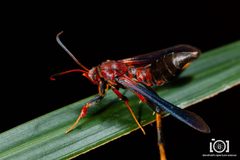
are clearwing moths with reduced wing scaling that leaves most of the wing transparent. The body typically shows yellow or orange banding on a dark background, contributing to -like appearance. Pupal cases are papery, brown, and protrude from round or oval exit holes in bark—distinct from the D-shaped exit holes of emerald ash borer (Agrilus planipennis). from larval galleries appears as sawdust-like material accumulating on bark and ground beneath trees.
Images
Habitat
Associated with woody plants in the Oleaceae, particularly in urban and suburban landscapes, parks, and natural stands of ash. Trees growing in stressful conditions—such as street plantings, parking lot islands, or drought-prone sites—are more susceptible to .
Distribution
North America; documented from the United States including Mississippi, Vermont, and broadly across the country where suitable plants occur.
Seasonality
timing varies by : Podosesia aureocincta emerges in late summer to autumn (August-September), while P. syringae emerges in spring to early summer. The USA National Network provides Pheno Forecast maps for P. syringae to predict emergence timing regionally.
Diet
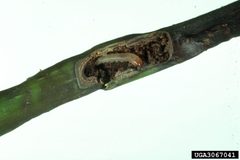
Larvae feed on the nutritious tissue beneath the bark of woody plants, tunneling through phloem and outer xylem. Specific feeding habits of are not documented in available sources.
Host Associations
- Fraxinus pennsylvanica - larval green ash; documented for P. syringae in Mississippi
- Syringa - larval lilac
- Ligustrum - larval privet
- Fraxinus - larval ash broadly
- Olea - larval olive
- Forsythia - larval documented for members
Life Cycle
Larvae bore into woody stems and roots, feeding beneath the bark for extended periods—typically one to two years depending on and conditions. Mature larvae pupate within their burrows. emerge through exit holes, leaving behind characteristic papery pupal cases. Females deposit on bark of trees; eggs hatch within days. Larval development continues through autumn, winter, and the following spring and summer.
Behavior
are and active during daylight hours. Females release to attract males for mating. The exhibits mimicry: adults resemble stinging paper wasps in coloration, body shape, and , likely conferring protection from .
Ecological Role
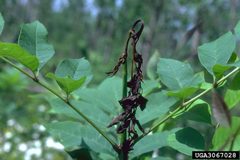
Larvae function as wood-boring pests of ornamental and native woody plants in the olive . can cause gradual tree decline over years or decades, particularly in stressed trees. The relatively slow impact contrasts with more aggressive pests such as emerald ash borer.
Human Relevance
Podosesia syringae is included in the USA National Network's Pheno Forecast program, which provides predictive maps for pest management professionals to optimize control timing. Larval boring damage affects ornamental ash, lilac, and related landscape plants, potentially requiring arboricultural intervention. Management options include cultural practices to reduce tree stress and targeted applications timed to .
Similar Taxa
- Agrilus planipennisBoth attack ash trees and cause thinning, dead branches, and epicormic sprouts. Distinguishable by D-shaped exit holes (Agrilus) versus round/oval holes with papery pupal cases (Podosesia); Agrilus is a with hard wing covers, Podosesia is a with clear wings and mimicry.
- Podosesia syringaeWithin- comparison: P. aureocincta and P. syringae are similar in and appearance but differ in timing—autumn versus spring/early summer.
Sources and further reading
- BugGuide
- Wikipedia
- GBIF taxonomy match
- iNaturalist taxon
- NCBI Taxonomy
- Catalogue of Life
- The lesser ash threat? Banded ash clearwing borer, Podosesia aureocincta — Bug of the Week
- National Phenology Network Aids Pest Management With Insect Forecast Maps
- Biology of an Ash Borer, Podosesia syringae,1 in Green Ash in Mississippi
- Biology of Podosesia (Lepidoptera: Sesiidae) with Description of a New Species from North America 1