
Podosesia syringae
(Harris, 1839)
Lilac Borer, Ash Borer, Lilac Borer Moth
Podosesia syringae, commonly known as the lilac borer or ash borer, is a clearwing moth in the Sesiidae found throughout Canada and the United States. The mimics the appearance of a paper wasp, with transparent wings lacking and a -like body form. Larvae tunnel beneath the bark of ash and lilac trees, feeding on the nutritious tissue and potentially causing significant damage over time. The is a pest of concern for arborists and forest managers, with timing predictable through phenological models based on heat accumulation.
Pronunciation
How to pronounce Podosesia syringae: /poˈdoʊ.si.si.ə sɪˈrɪŋ.ɡi.aɪ/
These audio files are automatically generated. While they are not always 100% accurate, they are a good starting point.
Identification
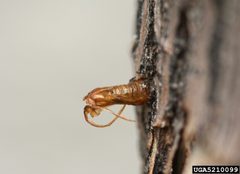
Distinguished from emerald ash borer (Agrilus planipennis) by round or oval exit holes rather than the characteristic D-shaped exit holes of the . Sawdust-like accumulation on bark and ground is a key sign, contrasting with the galleries of emerald ash borer. Papery pupal cases protruding from bark distinguish it from other borers that do not leave such structures. emerge in spring and early summer, unlike the related banded ash clearwing (Podosesia aureocincta) which emerges in autumn.
Images
Habitat
Associated with ash trees (Fraxinus spp.) and lilac (Syringa spp.), particularly in urban and suburban landscapes. Trees in stressful conditions—such as those planted along streets, in parking lot islands, or with limited root space—are more susceptible to .
Distribution
Throughout Canada and the United States. Specific records include Alberta, Manitoba, and Saskatchewan in Canada.
Seasonality
emerge and are active in spring and early summer. Larval development continues through autumn, spring, and summer. The USA National Network provides predictive forecast maps for timing based on heat accumulation models.
Diet
Larvae feed on the nutritious tissue beneath the bark of ash and lilac trees. do not feed.
Host Associations
- Fraxinus - larval ash trees
- Syringa - larval lilac
Life Cycle
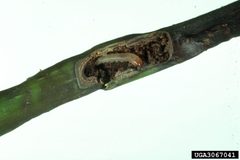
Females deposit on bark. Eggs hatch in days. Larvae tunnel beneath bark and feed, growing through autumn, spring, and summer. Mature larvae pupate, and emerge through round or oval exit holes in the bark, leaving papery pupal cases. One per year is typical.
Behavior
females release to attract males. Adults are and -mimicking in . Larvae bore beneath bark and expel from galleries.
Ecological Role
As a wood-boring insect, larvae contribute to the degradation of living woody tissue in trees. Their activity can stress or kill trees over time, potentially creating for other organisms in dead or dying wood.
Human Relevance
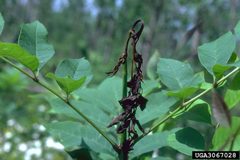
Significant pest of ornamental ash and lilac in urban and suburban landscapes. Damage from larval tunneling causes thinning, branch death, yellowing leaves, and water sprout formation. Managed through cultural practices that reduce tree stress and by certified arborists. Included in USA National Network Pheno Forecast maps to aid professionals in timing control measures.
Similar Taxa
- Podosesia aureocinctaAlso a clearwing borer of ash, but emerge in autumn rather than spring and early summer; has yellow band on
- Agrilus planipennisEmerald ash borer is a that kills trees rapidly and leaves D-shaped exit holes, unlike the round/oval holes and papery pupal cases of Podosesia syringae
More Details
Phenology Forecasting
The USA National Network includes Podosesia syringae in its Pheno Forecast program, using heat accumulation models to predict timing nationwide. This aids pest management professionals in optimizing control timing.
Sources and further reading
- BugGuide
- GBIF taxonomy match
- iNaturalist taxon
- NCBI Taxonomy
- Catalogue of Life
- National Phenology Network Aids Pest Management With Insect Forecast Maps
- The lesser ash threat? Banded ash clearwing borer, Podosesia aureocincta — Bug of the Week
- Biology of an Ash Borer, Podosesia syringae,1 in Green Ash in Mississippi