
Grotea
Cresson, 1864
Species Guides
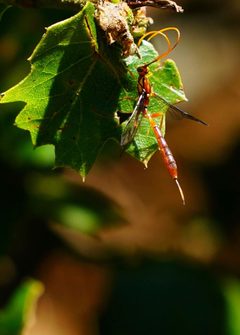
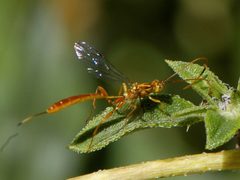
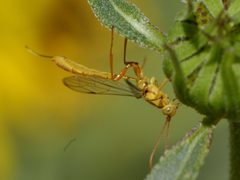
3Grotea is a of in the Ichneumonidae, Labeninae. in this genus are specialized parasitoids of cavity-nesting bees, particularly in the families Colletidae and Apidae. The genus has been documented across the Americas from the Greater Antilles to southern South America, with recent descriptions of new species from Colombia, Argentina, and Ecuador. Grotea species develop inside , with larvae occupying one or more neighboring cells within membranous cocoons.
Pronunciation
How to pronounce Grotea: /ˈɡroʊtiə/
These audio files are automatically generated. While they are not always 100% accurate, they are a good starting point.
Identification
Grotea can be distinguished from other Labeninae by morphological features including a distinct genal projection, often subquadrate apically; carina distinct only anteriorly to the transverse carina; and elongated mesosoma proportions (e.g., 2.9× as long as high in G. ambarosa). The is characterized by amber-orange to dark coloration with complex leg patterning in some species. An identification key for Neotropical species has been published.
Images
Habitat
Associated with nests of cavity-nesting bees in various environments including high-Andean , grassland with tussock grasses, and areas with suitable nesting substrates for bees. Specific microhabitats include hollow stems of native grasses and linear arrangements in trap-nest substrates.
Distribution
Neotropical region: documented from Colombia, Ecuador, Argentina (including southern Argentina), and the Greater Antilles (first Labeninae record for this region). Distribution extends across South America and into the Caribbean.
Seasonality
In high-Andean Colombia, associated Colletes paulae shows peak nesting activity in October–November with year-round nesting; presence corresponds to host availability. Specific periods for Grotea not documented.
Host Associations
- Colletes paulae - first confirmed - interaction between Grotea and Colletes; parasitoid reared from
- Hylaeus platensis - reared from nests in hollow stems of Cortaderia selloana
- Ceratina (Crewella) rupestris - for G. coca sp. nov.
Life Cycle
Larvae develop as within . In G. hylaeivora, large larvae occupy the length of two neighboring host cells within a membranous cocoon separated by disc partitions. Development occurs within the sealed brood cells of host bees.
Behavior
of solitary bees; females locate and oviposit into brood . rates have been observed to vary between types, with higher rates in conserved versus restored habitats in one Colombian study.
Ecological Role
of cavity-nesting bees; may function as indicators of integrity based on observed patterns of rates across quality gradients.
Similar Taxa
- other Labeninae generaGrotea distinguished by combination of genal projection , carina structure, and mesosoma proportions; identification keys available for regional
More Details
Taxonomic notes
Grotea has been used as a name in other (Sesiidae, Erebidae, Colubridae, plants) but these are synonyms or unrelated; the valid zoological usage is for Ichneumonidae .
Research significance
Recent descriptions of G. colletiphaga and G. hylaeivora have expanded known associations and geographic range; these possess plesiomorphic characteristics suggesting phylogenetic importance for understanding Grotea evolution.
Sources and further reading
- BugGuide
- Wikipedia
- GBIF taxonomy match
- iNaturalist taxon
- NCBI Taxonomy
- Catalogue of Life
- A new species of Grotea (Hymenoptera: Ichneumonidae) in Argentina: systematics and biological notes
- A new species of Grotea Cresson, the first record of Labeninae (Hymenoptera, Ichneumonidae) in the Greater Antilles
- Nesting ecology of the bee Hylaeus (Hylaeopsis) platensis n. sp. (Colletidae, Hylaeinae) with description of its parasite, Grotea hylaeivora n. sp. (Ichneumonidae, Labeninae)
- Nesting biology and phenology of a new Andean Colletes (Colletidae: Colletinae) from Colombia, with the description of a new parasitoid species of Grotea (Ichneumonidae: Labeninae)
- New Species of Grotea (Hymenoptera, Ichneumonidae, Labeninae) from Ecuador, with New Records and a Key to the Neotropical Species.