
Colletes
Latreille, 1802
plasterer bees, cellophane bees, polyester bees
Species Guides
25- Colletes aberrans(Aberrant Cellophane Bee)
- Colletes aestivalis(Alumroot Cellophane Bee)
- Colletes birkmanni(polyester bee)
- Colletes bryanti
- Colletes compactus(polyester bee)
- Colletes fulgidus(Glittering Cellophane Bee)
- Colletes howardi
- Colletes hyalinus(polyester bee)
- Colletes inaequalis(Unequal Cellophane Bee)
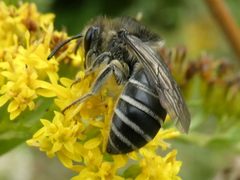
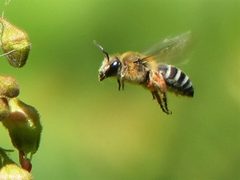
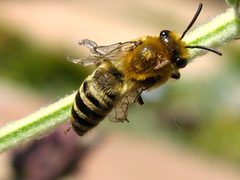
Colletes is a large of solitary ground-nesting bees in the Colletidae, comprising approximately 470 described with an estimated total around 700. are small, typically 1–2 cm long, with dense pale hair and distinctive wing venation. Females construct individual underground burrows lined with a unique polyester secretion from the , creating a cellophane-like waterproof coating that gives these bees their . They are among the earliest native bees to emerge in spring and are important , with many species showing specialized pollen-foraging preferences.
Pronunciation
How to pronounce Colletes: /kɔˈliːtiːz/
These audio files are automatically generated. While they are not always 100% accurate, they are a good starting point.
Identification
Colletes bees resemble small honey bees or mining bees (Andrena) in general form. Key diagnostic features include: a two-lobed (bifurcated) tongue visible when extended; the second recurrent wing in the forewing is distinctly S-shaped (sinuous) rather than straight; and the first abdominal segment (propodeum) has a longitudinally crested basal zone that ends abruptly with a crosswise ridge. Males have longer than females and lack the pollen-collecting scopa on the hind legs. The appears -shaped in -on view, contrasting with the more rounded face of Andrena.
Images
Habitat
Sandy or well-drained soils with sparse vegetation; often found in coastal sand dunes, machair, thin lawns, golf course roughs, and bare patches in grasslands. Requires soils that are somewhat sandy and not too humid for successful nesting. Nesting can occur in sunny locations with thousands of females occupying small areas.
Distribution
Almost worldwide but primarily Northern Hemisphere; absent from Antarctica, Australia, Madagascar, and Southeast Asia. Approximately 100 in North America north of Mexico, about 60 in Europe, with greatest diversity in temperate to subtropical Asia, particularly Central Asia.
Seasonality
Among the first solitary bees to appear in spring; some are with one per year in spring or fall, while others are with two generations. Activity extends into autumn in some regions.
Diet
feed on nectar; females collect pollen primarily from non-Asteraceae sources despite the abundance of Asteraceae in many . Western Palearctic show strong specialization on Campanulaceae, Fabaceae, and Rosaceae. Many species are oligolectic, foraging on one or few related plant species, while others are polylectic with broader floral preferences.
Life Cycle
Females excavate individual underground burrows up to 26 cm deep, creating lined with a polyester secretion. Each cell receives a semi-liquid provision of nectar and pollen, followed by a single . Larvae develop through summer and fall, pupating to emerge the following year. No ; each female provisions her own nest.
Behavior
Solitary but often nest in dense with hundreds to thousands of burrows in small areas. Males emerge first (protandry) and actively patrol nesting sites seeking females, forming mating balls when multiple males pursue one female. Excavation produces audible buzzing that may aid soil loosening. Females apply glandular secretions to walls using mouthparts like a trowel. Emit citrus-like odor from gland when handled, containing linalool and other compounds that may function in mate or nest location. Extremely docile; females rarely sting even when handled.
Ecological Role
Important native , with some acting as keystone pollinators for early spring flora. Some are economically significant as pollinators of fruit trees, green manure plants, and Ericaceae. Males of some species are the exclusive pollinators of certain Ophrys orchids through sexual deception. Nests are parasitized by cuckoo bees (Epeolus) and Stenoria beetles.
Human Relevance
Beneficial with no tendency to sting; large nesting sometimes cause concern among homeowners and golf course managers, though the bees are harmless and do not damage turf. Conservation of nesting sites is important as can be eliminated by application or destruction.
Similar Taxa
- AndrenaMining bees overlap in and general appearance; distinguished by straight second recurrent wing and rounded in -on view.
- HalictusSweat bees share small size and ground-nesting habits; Halictus and Lasioglossum lack the S-shaped second recurrent and two-lobed tongue of Colletes.
- EpeolusCuckoo bees parasitize Colletes nests and may be found at nesting sites; females have specialized abdominal spines for cutting through the polyester lining.
Sources and further reading
- BugGuide
- Wikipedia
- GBIF taxonomy match
- NCBI Taxonomy
- Catalogue of Life
- An introduction to the Northern Colletes mining bee - Buglife Blog - Buglife
- Boisterous bee-havior of ground nesting bees, Colletes thoracicus — Bug of the Week
- Spring sunshine heralds the appearance of plasterer bees: Colletes — Bug of the Week
- Spring arrives and with it, delightful Plasterer bees: Colletes spp. — Bug of the Week
- Spring sunshine heralds the appearance of plasterer bees, Colletes — Bug of the Week
- Bug Eric: Polyester Bees
- Pollen hosts of western palaearctic bees of the genus Colletes (Hymenoptera: Colletidae): the Asteraceae paradox
- New and little-known bees of the genus Colletes Latreille, 1802 (Hymenoptera, Colletidae) from the Nakhchivan Autonomous Republic of Azerbaijan, with descriptions of two new species.