
Colletes aestivalis
Patton, 1879
Alumroot Cellophane Bee, Summer Cellophane Bee
Colletes aestivalis is a solitary ground-nesting in the Colletidae, commonly known as the Alumroot Cellophane Bee. It is one of approximately 99 Colletes in North America. Like other members of its , females construct individual burrows in sandy soils and line with a distinctive cellophane-like secretion from the . The specific epithet 'aestivalis' (Latin for 'of summer') reflects its summer period, distinguishing it from many that are active in spring or fall.
Pronunciation
How to pronounce Colletes aestivalis: /kɔˈlɛteɪz aɪˈstɪvəlɪs/
These audio files are automatically generated. While they are not always 100% accurate, they are a good starting point.
Identification
Difficult to distinguish from and similar without close examination. The S-shaped second recurrent in the forewing separates Colletes from Andrena (where this vein is relatively straight). The -shaped distinguishes Colletes from the round-faced Andrena. Confirmation to level requires microscopic examination; summer period helps separate C. aestivalis from spring- and fall-active congeners.
Images
Appearance
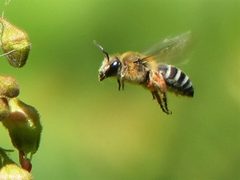
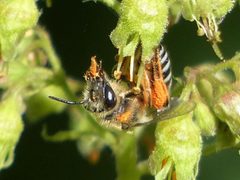
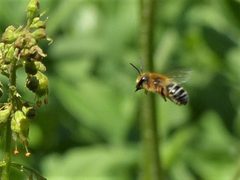
Medium-sized with a -shaped when viewed -on. The forewing has three submarginal beneath the marginal cell. The second recurrent is distinctly sinuous (S-shaped), a key diagnostic feature. Females possess a brush of pollen-collecting hairs (scopa) on the hind legs; males lack this scopa and have longer .
Habitat
Sandy soils with sparse vegetation, including bare patches in lawns, coastal dunes, and open ground. Nests in where soil conditions permit. Requires sunny locations for nesting sites.
Distribution
North America; present across the continent with records from multiple regions. Specific range boundaries not well documented.
Seasonality
active in summer (June–August), distinguishing this from many that fly in spring or fall. with one per year.
Life Cycle
Females excavate individual burrows up to 26 cm deep in sandy soil. Each burrow contains multiple lined with a waterproof, cellophane-like secretion from the applied over a base layer of saliva. Each cell receives a single and is provisioned with a semi-liquid mixture of nectar and pollen. Larvae develop through summer and fall, pupating to emerge the following summer.
Behavior
Solitary but nests in dense that may contain hundreds to thousands of individuals in favorable sites. Males emerge first (protandry) and actively pursue females, forming mating balls. Males patrol nesting areas and frequently land on the ground. Females are continuously active, entering and leaving burrows to forage and provision . Docile and extremely reluctant to sting; females risk reproductive failure if they sting and die.
Ecological Role
of flowering plants. Specific plant relationships not documented, but may be oligolectic (specialized to particular plant ) or polylectic () like other Colletes .
Human Relevance
Beneficial that poses minimal sting risk. Large in lawns sometimes cause concern but should be conserved. can be eliminated by use or destruction. Increasing turf through overseeding and irrigation reduces nesting suitability if removal is desired.
Similar Taxa
- Colletes inaequalisSpring-active with overlapping range; distinguished by earlier period
- Colletes thoracicusSpring-active ; distinguished by earlier period and subtle morphological differences requiring microscopic examination
- Andrena spp.Mining bees with similar ground-nesting ; distinguished by straight second recurrent and round
- Halictus spp.Sweat bees of similar size; distinguished by different wing venation and lack of cellophane lining
- Lasioglossum spp.Small sweat bees that may co-occur; distinguished by different wing venation and nesting
More Details
Nesting Biology
The cellophane-like lining secreted by females creates a 'plastic baggie' that maintains freshness of the liquid provisions for developing larvae. This unique nesting gives the its of 'polyester bees,' 'plasterer bees,' and 'cellophane bees.'
Aggregation Persistence
Nesting may occupy the same location year after year when soil conditions remain favorable, making site protection important for persistence.
Sources and further reading
- BugGuide
- GBIF taxonomy match
- iNaturalist taxon
- Catalogue of Life
- An introduction to the Northern Colletes mining bee - Buglife Blog - Buglife
- Boisterous bee-havior of ground nesting bees, Colletes thoracicus — Bug of the Week
- Spring sunshine heralds the appearance of plasterer bees: Colletes — Bug of the Week
- Spring arrives and with it, delightful Plasterer bees: Colletes spp. — Bug of the Week
- Spring sunshine heralds the appearance of plasterer bees, Colletes — Bug of the Week
- Bug Eric: Polyester Bees