
Colletes inaequalis
Say, 1837
Unequal Cellophane Bee, Plasterer Bee, Polyester Bee
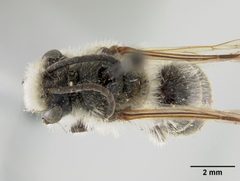
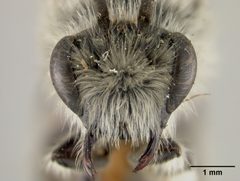
Colletes inaequalis is a , ground-nesting solitary and one of the earliest to emerge in North American spring. Males emerge approximately two weeks before females and patrol nesting sites seeking mates. Females construct individual underground burrows in sandy soils, lining with a polyester secretion from abdominal glands that creates a waterproof, cellophane-like coating. The exhibits strong site fidelity, with offspring often nesting near parental sites. It is polylectic, visiting early spring flowering trees including Eastern Redbud, maple, willow, and apple.
Pronunciation
How to pronounce Colletes inaequalis: /kəˈliːtiːz ˌɪniːˈkwɑːlɪs/
These audio files are automatically generated. While they are not always 100% accurate, they are a good starting point.
Identification
Distinguished from similar Colletes by its early spring period and association with specific plants. Males are noticeably smaller than females. When handled, emits a distinctive citrus-like odor from gland secretions containing linalool. Nests can be identified by the cellophane-like lining visible in excavated . may contain several burrows per square meter in suitable .
Images
Habitat
Ground-nesting in bare or thinly vegetated sandy soils. Nests constructed in open, sunny locations including lawns, parks, golf courses, and forest edges. Burrow depths range from 7–39 cm, with records to 86 cm. Requires well-drained soils; does not create thin turf but colonizes naturally sparse vegetation.
Distribution
Eastern United States and adjacent southern Canada. Western limit approximately Kansas; northern records extend to Saskatchewan.
Seasonality
activity confined to early spring. Males emerge first, often when snow may still be present and before floral resources are consistently available. Adult activity ceases by early summer.
Diet
Polylectic ; collects pollen and nectar from early spring flowering trees. Documented visits to Eastern Redbud (Cercis canadensis), maple (Acer spp.), willow (Salix spp.), and apple (Malus spp.).
Host Associations
- Tricrania sanguinipennis - Blister beetle larvae (triungulins) attach to male bees, transfer to females during mating, and consume and pollen stores in nest
Life Cycle
with one annually. Larvae develop through summer and fall, entering prepupal stage. stage uncertain but likely as within sealed . Six larval instars with in Tricrania sanguinipennis.
Behavior
Protandrous with males appearing approximately two weeks before females. Males patrol nesting sites, investigate potential emergence sites, and compete for access to females. Females dig burrows using mouthparts, accompanied by buzzing that may loosen soil particles. Strong philopatry with site fidelity across . Docile and reluctant to sting; females risk reproductive failure if they sting and die.
Ecological Role
Key early-season of native wild plants and economically important crops including apples and blueberries. Provides pollination services when few other bees are active. Nesting can reach high densities in suitable .
Human Relevance
Beneficial of orchard crops. Occasionally perceived as nuisance when large form in lawns or recreational areas, but poses minimal sting risk. Management through overseeding and irrigation can reduce nesting suitability if removal desired.
Similar Taxa
- Colletes thoracicusSympatric vernal plasterer bee with similar and ; distinguished by subtle morphological differences and plant associations
- Colletes validusSympatric vernal plasterer bee sharing nesting and temporal ; requires expert identification
More Details
Thermal Physiology
Exhibits physiological to early spring cold conditions. Critical thermal minimum approximately 4.7–5.4°C; critical thermal maximum approximately 43–44°C. Significantly more cold-tolerant but less heat-tolerant than Apis mellifera, with faster chill coma recovery. Repeated cold exposure impairs recovery ability. Food availability is primary factor influencing male survival when emerging before floral resources.
Nest Construction
lined with polyester secretion from , creating transparent waterproof that retards mold and fungus. Each nest contains up to seven cells provisioned with semi-liquid pollen and nectar mixture.
Sources and further reading
- BugGuide
- GBIF taxonomy match
- iNaturalist taxon
- NCBI Taxonomy
- Catalogue of Life
- Bug Eric: The Beetle and the Bee
- Spring sunshine heralds the appearance of plasterer bees: Colletes — Bug of the Week
- Boisterous bee-havior of ground nesting bees, Colletes thoracicus — Bug of the Week
- Spring arrives and with it, delightful Plasterer bees: Colletes spp. — Bug of the Week
- Spring sunshine heralds the appearance of plasterer bees, Colletes — Bug of the Week
- Thermal Tolerance in the Cellophane Bee Colletes inaequalis Reflects Early Spring Adaptation and Is Independent of Body Size and Sex