
Tricrania sanguinipennis
(Say, 1823)
Blood-winged Blister Beetle
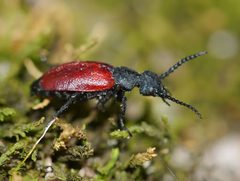
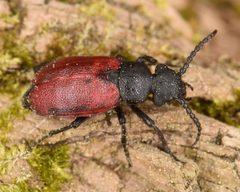
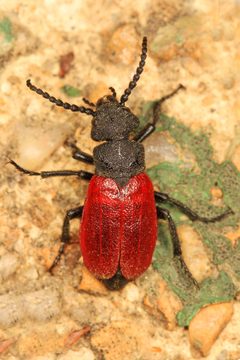
Tricrania sanguinipennis is a flightless blister beetle ( Meloidae) native to eastern North America. are 9–15 mm long with bright red, leathery that conceal wings. The is a of solitary bees in the Colletes, particularly Colletes inaequalis. Its involves , with a mobile triungulin larva that hitchhikes on male bees to access underground nest . The has been documented from Saskatchewan to northern Florida, with Kansas marking its western limit.
Pronunciation
How to pronounce Tricrania sanguinipennis: /trɪˈkreɪniə ˌsæŋɡwɪnɪˈpɛnɪs/
These audio files are automatically generated. While they are not always 100% accurate, they are a good starting point.
Identification
Distinguished from other Tricrania by coloration and geographic range; T. stansburyi is the only other congeneric species in North America, and the two have been subject to taxonomic revision. The wings and flightless condition separate it from most other meloid beetles in its range. (565- COI fragment) is available for definitive identification. First instar larvae (triungulins) are sleek, streamlined, and highly mobile—distinctly different from later instars.
Images
Habitat
Distribution
Eastern North America from Saskatchewan and southern Canada south to extreme northern Florida. Western limit approximately Kansas. Records from Ontario, Québec, Vermont, and throughout the eastern United States.
Seasonality
active from late February through March in warmer years, typically emerging early spring. tied to . occurs as adults encased in larval within host nest .
Host Associations
- Colletes inaequalis - Unequal Cellophane Bee; primary . Triungulin larvae attach to male bees, transfer to females during mating, and are carried to underground nest .
- Colletes spp. - Other cellophane bees in dense nesting ; specificity centered on Colletes.
Life Cycle
Hypermetamorphic with six larval instars. First instar (triungulin) is mobile, attaches to bees, and enters nest . Immediately consumes host or larva, then to second instar. Instars 2–6 are sedentary, boat-shaped, and feed on pollen/nectar stores. Instars 4–5 retain (like nested balloons), shrinking to fit inside. Pupa forms within retained exuviae. overwinters in host cell, emerging following spring.
Behavior
crawl rapidly over soil, digging periodically to detect . Flightless; all locomotion by . Females deposit hundreds to over one thousand . Triungulin larvae actively seek and board male bees, transferring to females during mating. occurs when multiple larvae invade single host .
Ecological Role
Human Relevance
Of interest to entomologists studying - relationships and . No significant agricultural or medical importance. Can be observed in urban and suburban settings where host bees nest in lawns. Climate change effects on host plant (Eastern Redbud, maple flowering) may indirectly threaten .
Similar Taxa
- Tricrania stansburyiOnly other in Tricrania; historically confused but now distinguished through taxonomic revision. T. stansburyi has different distribution and associations.
- Epicauta spp.Other common North American blister beetles; distinguished by functional wings, different coloration patterns, and plant-feeding (not ) .
- Meloe spp.Oil beetles share hypermetamorphic but have different associations (typically bees in other ) and ; often larger with different body proportions.
More Details
Taxonomic history
Subject of 2011 revision (Zootaxa 2832) that clarified boundaries and synonymized T. murrayi with T. stansburyi. Over 1000 specimens examined for data, , and distribution.
Research significance
Classic study organism for and triungulin . Parker and Böving (1925) provided exhaustive morphological descriptions of all life stages.
Conservation notes
More threatened by phenological mismatch between bees and flowering trees (Eastern Redbud, maples) due to climate change than by pressure on host .
Sources and further reading
- BugGuide
- Wikipedia
- GBIF taxonomy match
- iNaturalist taxon
- NCBI Taxonomy
- Meloidae Holdings | Entomology Research Museum
- Bug Eric: The Beetle and the Bee
- The blister beetle Tricrania sanguinipennis—biology, descriptions of different stages, and systematic relationship
- Revision of the nearctic blister beetle genus Tricrania LeConte, 1860 (Coleoptera: Meloidae: Nemognathinae)