
Tricrania stansburyi
(Haldeman, 1852)
Stansbury's Blister Beetle
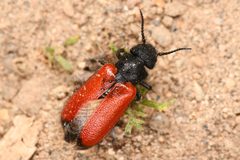
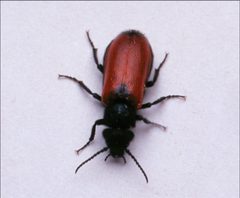
Tricrania stansburyi is a blister beetle in the Meloidae. It is a of solitary bees, specifically known to parasitize the Osmia lignaria propinqua. The exhibits , with triungulin larvae attaching to bees to gain entry to nest . It is found in North America and is one of at least two species in the Tricrania.
Pronunciation
How to pronounce Tricrania stansburyi: /trɪˈkreɪniə stænsˈbʌri/
These audio files are automatically generated. While they are not always 100% accurate, they are a good starting point.
Identification
Belongs to the Tricrania, which can be distinguished from related blister beetles by specific morphological features. The genus Tricrania contains with reduced wings and flightless . T. stansburyi may be distinguished from the congeneric T. sanguinipennis by differences in distribution and associations; T. sanguinipennis is associated with Colletes bees in eastern North America, while T. stansburyi is associated with Osmia bees in western regions.
Images
Habitat
Nests of the solitary Osmia lignaria propinqua, which typically occur in pre-existing cavities or hollow stems.
Distribution
North America. Records from the Entomology Research Museum indicate western North American distribution, with the being the western counterpart to the eastern T. sanguinipennis.
Diet
Pollen provisions and developing larvae of the Osmia lignaria propinqua. diet not documented.
Host Associations
- Osmia lignaria propinqua - larvae consume pollen provisions and developing larvae within nest
Life Cycle
Hypermetamorphic with six larval instars. First instar is a triungulin that attaches to bees to be transported to nest . Once inside a cell, the larva consumes the host or larva, then into a sedentary, boat-shaped second instar that feeds on remaining pollen provisions. Instars 4-5 retain shed (accumulating as nested layers). The adult overwinters within the final larval inside the host nest cell.
Behavior
Female beetles are flightless and crawl rapidly over soil surfaces, digging where presence is detected. Triungulin larvae actively seek host bees, attaching to males and transferring to females during mating, or attaching directly to females on the ground. Multiple larvae may invade a single host , with resolving competition.
Ecological Role
and of solitary . Despite significant rates, bee populations persist, suggesting the relationship is not severely destabilizing to host populations under normal conditions.
Similar Taxa
- Tricrania sanguinipennisCongeneric with similar hypermetamorphic cleptoparasitic , but associated with Colletes bees in eastern North America rather than Osmia bees in the west; have red and wings
More Details
Taxonomic authority
Originally described by Haldeman in 1852.
Specimen holdings
The Entomology Research Museum at the University of California, Riverside holds 20 specimens of this as of 2010.