
Tricrania
LeConte, 1860
Species Guides
2- Tricrania sanguinipennis(Blood-winged Blister Beetle)
- Tricrania stansburyi(Stansbury's Blister Beetle)
Tricrania is a of Nearctic blister beetles (Meloidae: Nemognathinae) containing at least three described , including T. sanguinipennis and T. stansburyi. These beetles are obligate of solitary bees, with highly modified involving and flightless . The genus is notable for its specialized larval stages that exploit nest .
Pronunciation
How to pronounce Tricrania: //traɪˈkreɪniə//
These audio files are automatically generated. While they are not always 100% accurate, they are a good starting point.
Identification
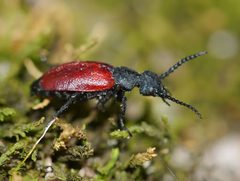
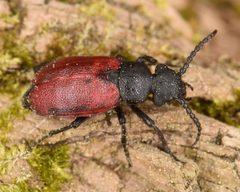
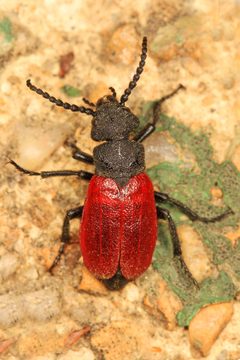
of Tricrania are distinguished from related Nemognathinae by reduced, nearly wings concealed beneath red, leathery , rendering them flightless. T. sanguinipennis measures 9–15 mm and exhibits bright red elytra. T. stansburyi and T. sanguinipennis can be separated using diagnostic characters in adult and larval structure; a 565- COI barcode fragment is available for molecular identification. First instar larvae (triungulins) are sleek, streamlined, and highly mobile, contrasting sharply with the rotund, boat-shaped second through sixth instars.
Images
Habitat
Distribution
Nearctic region. T. sanguinipennis occurs from extreme northern Florida northward through the eastern United States into southern Canada (Saskatchewan), with western limit at approximately Kansas. T. stansburyi distribution overlaps but with distinct range boundaries; precise limits established from assessment of over 1100 specimens.
Seasonality
active in early spring, with timed to coincide with activity. T. sanguinipennis has been observed from late February through March in mild winters, with phenological periods documented from specimen assessments exceeding 1000 individuals.
Host Associations
- Colletes inaequalis - Cellophane bee; primary for T. sanguinipennis. larvae consume or larva, then pollen and nectar provisions.
- Osmia lignaria propinqua - ; confirmed for T. stansburyi. Cleptoparasitic development within nest .
Life Cycle
Hypermetamorphic with six larval instars. First instar (triungulin) is mobile, attaches to male bees and transfers to females during mating, or attaches directly to females on the ground. Once transported to nest burrow, triungulin infiltrates subterranean , consumes or larva, then to second instar. Instars 2–6 are sedentary, boat-shaped, and feed on pollen and nectar provisions. Instars 4–5 retain entire of previous molts, shrinking to fit inside; sixth instar compacts shed exoskeletons at rear of pupa. overwinters encased in final larval within host cell, emerging in spring.
Behavior
Female beetles exhibit high , producing hundreds to over one thousand . are flightless and crawl rapidly over soil, digging to locate nests. First instar larvae actively seek host bees, using phoretic transport on male bees with subsequent transfer to females. Multiple larvae may invade single , with resolving competition. Adults remain inactive within host nest cells through winter.
Ecological Role
Specialized of solitary bees. suggest limited impact on abundance despite high individual ; primary threat to hosts appears to be phenological mismatch with nectar plants due to climate variability rather than pressure.
Human Relevance
None documented. Not known to cause blistering in humans; no agricultural or medical significance established. Subject of entomological research due to specialized parasitic .
Similar Taxa
- EpicautaBoth are Meloidae with bright coloration, but Epicauta are fully winged and capable of , with larvae that are not hypermetamorphic .
- MeloeBoth exhibit and have flightless with reduced wings, but Meloe are generally larger, have different associations (typically pods or nests for some ), and lack the bright red characteristic of Tricrania.
- NemognathaSame Nemognathinae with similar cleptoparasitic habits on bees, but Nemognatha are typically winged as and have different larval and associations.
More Details
Taxonomic history
revised by Pinto (2011, Zootaxa 2832), with T. murrayi LeConte 1860 synonymized under T. stansburii (Haldeman) 1852. Placement in Nemognathinae confirmed despite historical uncertainties.
Conservation implications
Climate change poses indirect threat through phenological mismatch between bees (dependent on early-flowering trees such as Eastern Redbud and maple) and their nectar resources, potentially disrupting the 's .
Sources and further reading
- BugGuide
- GBIF taxonomy match
- iNaturalist taxon
- NCBI Taxonomy
- Catalogue of Life
- Meloidae Holdings | Entomology Research Museum
- Bug Eric: The Beetle and the Bee
- The blister beetle Tricrania sanguinipennis—biology, descriptions of different stages, and systematic relationship
- Revision of the nearctic blister beetle genus Tricrania LeConte, 1860 (Coleoptera: Meloidae: Nemognathinae)
- Biology of Tricrania stansburyi, a Meloid Beetle Cleptoparasite of the Bee Osmia lignaria propinqua (Hymenoptera: Megachilidae)