
Meloe
Linnaeus, 1758
Oil Beetles
Species Guides
15- Meloe ajax
- Meloe americanus(Buttercup Oil Beetle)
- Meloe angusticollis(short-winged blister beetle)
- Meloe barbarus(oil beetle)
- Meloe bitoricollis
- Meloe campanicollis
- Meloe carbonaceus(oil beetle)
- Meloe dianella
- Meloe dugesi
Meloe is a large of blister beetles commonly known as oil beetles, named for their defensive release of oily containing from leg joints and other body when disturbed. are flightless with shortened that expose most of the , often displaying iridescent blue, green, or black coloration. The genus exhibits hypermetamorphic development with triungulin larvae that employ phoretic transport on bees to access nests, where they consume provisions and host offspring.
Pronunciation
How to pronounce Meloe: /ˈmɛloʊ.iː/
These audio files are automatically generated. While they are not always 100% accurate, they are a good starting point.
Identification
Distinguished from other meloid by the combination of flightlessness, greatly abbreviated exposing most of the , and the resulting 'oil beetle' appearance. The defensive secretion of orange from leg joints and when handled is diagnostic for the group. Male antennal varies among and can be used for species-level identification. Similar to other Meloinae but separable by the extreme reduction of elytra and complete absence of functional wings.
Images
Appearance
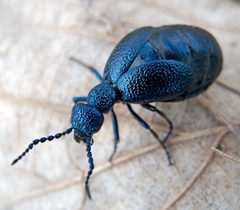
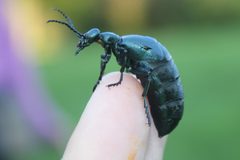
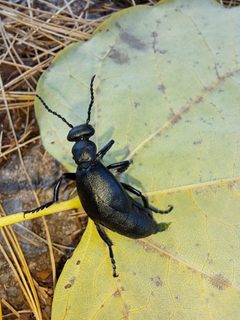
are robust beetles with distinctly shortened that leave most of the exposed, creating a 'waistcoat' appearance. Coloration ranges from iridescent blue, green, or black, often with a metallic sheen. The body surface is typically covered with pits or punctures on the elytra and . Males of some possess with distinct kinks or modifications, with antennal shape varying among species. Adults lack functional wings and are incapable of . Body size varies among species, with some reaching over 2.5 cm in length.
Habitat
occupy diverse open including grasslands, heathlands, coastal dunes, meadows, and wildflower-rich areas. Specific show habitat preferences: Meloe franciscanus occurs in Mojave Desert sand dunes where adults feed on Astragalus lentiginosus; Scottish species inhabit coastal areas, grassland, and heathland. Adults require sunny conditions and are most active on warm days.
Distribution
Widespread across the Holarctic region. Documented from North America (including Vermont, Mojave Desert, Oregon coastal dunes), Europe (including UK, Scandinavia, Mediterranean region), and Asia. Specific distribution varies by : Meloe proscarabaeus, M. violaceus, and M. brevicollis occur in the UK (with M. brevicollis in Scotland and the Hebrides); M. franciscanus in California and Oregon; numerous species across Europe and Asia.
Seasonality
emerge in spring, with activity typically from March through June in temperate regions. Meloe franciscanus adults emerge in winter months (January) in the Mojave Desert. Activity peaks on sunny days. Larval development occurs within nests, with timing synchronized to bee .
Diet
feed on leaves of herbaceous plants, with documented consumption of in Ranunculaceae, Convolvulaceae, Solanaceae, and Fabaceae (Astragalus lentiginosus). Specific plants include Jimson weed (Datura), buttercups, and milkvetches. Larvae consume pollen provisions and larvae within host nests.
Host Associations
- Habropoda pallida - for Meloe franciscanus in Mojave Desert; larvae mimic female to attract males
- Habropoda miserabilis - for M. franciscanus in Oregon coastal dunes
- Nomia melanderi - association documented
- Andrena - Mining bee for various Meloe
- Colletes - Plasterer bee
Life Cycle
Hypermetamorphic development with four larval instars. First instar (triungulin) is mobile and climbs vegetation to await bees, attaching to visiting bees for phoretic transport to nests. If attached to male bees, triungulins transfer to females during mating. Once in nests, larvae to a sedentary -like second instar that consumes pollen provisions and host larvae. Third and fourth instars are quiescent, non-feeding stages. occurs in the soil. timing varies by and region.
Behavior
Defensive involves releasing orange containing from leg joints, neck, and when threatened. Mating behavior involves males mounting females and releasing chemical components through antennal kinks to calm females, with cantharidin transfer to females who coat with the compound. Females excavate burrows in soil near nests and deposit eggs underground; some observations suggest egg deposition directly into bee burrows. Triungulin larvae exhibit cooperative behavior, collectively mimicking of female bees to attract male hosts.
Ecological Role
As larvae, Meloe function as nest or of solitary bees, potentially impacting . are herbivores that may influence plant through foliage consumption. The content makes them chemically defended, reducing pressure and potentially affecting dynamics. Local to specific bee may contribute to bee community structure and parasite-host .
Human Relevance
causes severe blistering of human skin upon contact; handling beetles is hazardous. Cantharidin-contaminated hay has caused lethal poisoning in horses and livestock. Historically, cantharidin (Spanish fly, from Lytta vesicatoria) was used medicinally and as an aphrodisiac, with documented fatal overdoses. The is subject to citizen science monitoring (Scottish Oil Beetle Hunt, National Oil Beetle Recording scheme) due to conservation concerns; two UK (M. variegatus, M. cicatricosus) are extinct. Research on Meloe franciscanus has advanced understanding of chemical mimicry and - .
Similar Taxa
- LyttaSimilar blister beetle but Lytta typically have fully developed covering the and are capable of
- EpicautaRelated meloid with complete and functional wings; are not flightless and lack the abbreviated elytra characteristic of Meloe
- BerberomeloeOld World oil beetle with similar flightless, abbreviated- ; distinguished by geographic distribution and male genitalic differences
Misconceptions
Meloe larvae are sometimes termed , but they do not strictly qualify as they can often survive on pollen provisions alone without killing the larva. The name is occasionally confused with MELOE-1, a human melanoma antigen unrelated to these beetles.
More Details
Chemical Ecology
Meloe franciscanus exhibit local in chemical signals: triungulins from Oregon and California populations mimic the specific compositions of their respective Habropoda , despite being . This involves variation in long-chain hydrocarbon position of double bonds and component proportions.
Conservation Status
UK have experienced range contractions; Meloe variegatus (Rainbow Oil Beetle) and M. cicatricosus (Scarred Oil Beetle) are extinct in the UK. The Short-necked Oil Beetle (M. brevicollis) has shown recent range expansion in the Hebrides from 2 sites (2021) to 10 sites (2025) following targeted surveys.
Subgeneric Classification
The includes multiple subgenera: Meloe (Meloe), Meloe (Treiodous), Meloe (Eurymeloe), Meloe (Lampromeloe), Meloe (Lasiomeloe), Meloe (Listromeloe), Meloe (Meloegonius), Meloe (Mesomeloe), Meloe (Micromeloe), Meloe (Taphromeloe), and others in the Old World.
Sources and further reading
- BugGuide
- Wikipedia
- GBIF taxonomy match
- iNaturalist taxon
- NCBI Taxonomy
- Catalogue of Life
- Meloidae Holdings | Entomology Research Museum
- The Amazing Bee-Parasite Research of Leslie Saul-Gershenz | Bug Squad
- Ground nesting bees beware of blister beetles - Meloe spp. — Bug of the Week
- Blistering beetles - Meloe spp. — Bug of the Week
- Springing into action – oil beetles and citizen science! - Buglife Blog - Buglife
- Phoretic Relationships of the Blister Beetle Meloe (Meloe) Strigulosus Mannerheim (Coleoptera: Meloidae) from a Coastal Dune Habitat in Oregon
- hnRNP‐A1 binds to the IRES of MELOE‐1 antigen to promote MELOE‐1 translation in stressed melanoma cells
- Meloenest parasites locally adapt chemistry and behavior to match bee hosts