
Meloe angusticollis
Say, 1824
short-winged blister beetle, oil beetle
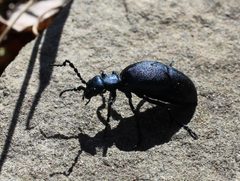
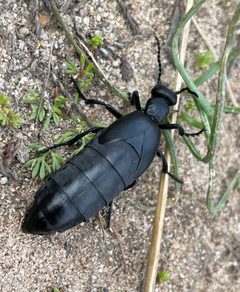
Meloe angusticollis is a North American blister beetle known for its short that leave most of the exposed. release -laden as a chemical defense, which causes skin blistering in humans. The exhibits , with mobile first-instar larvae (triungulins) that parasitize solitary bees by hitchhiking to nest sites. Females are notably larger than males, reaching up to 19 mm.
Pronunciation
How to pronounce Meloe angusticollis: //ˈmɛloʊ i ænˌɡʌstɪˈkɒlɪs//
These audio files are automatically generated. While they are not always 100% accurate, they are a good starting point.
Identification
Distinguished from by moderate to dense punctation on the and pronotum, combined with a conically produced scutellum. are extremely short, not reaching the end of the , giving a 'waistcoat' appearance. Body color is black or metallic blue with sparse, short setae matching the . Outer metathoracic tibial spur has the portion produced anteriorly. Females average 9–19 mm; males are smaller.
Images
Habitat
Found in open including grasslands, meadows, and areas with wildflower-rich vegetation. Associated with habitats supporting solitary bees, which serve as for larvae.
Distribution
Northern half of the United States and southern Canada. Records include Alberta, British Columbia, and Manitoba in Canada.
Seasonality
Active primarily during spring and early summer. emerge in spring, with peak activity from March through June depending on latitude.
Diet
feed on leafy vegetation including Astragalus and other herbaceous plants. Larvae are of solitary bees, consuming nest provisions and .
Host Associations
- Solitary bees (Apidae, various genera) - Triungulin larvae hitchhike on bees to reach nests
- Astragalus lentiginosus - food plant food source at some localities
Life Cycle
Complete with . laid in soil, often near or within burrows. First-instar larvae (triungulins) are mobile with well-developed legs; later instars become sedentary and engorged. Triungulins climb vegetation to await bees, attach to visiting females, and are transported to nests where they feed on provisions and eggs. Overwinters as late-stage larva, pupates in spring. Typically one per year.
Behavior
release oily droplets of from leg joints and body when disturbed, containing . Females excavate soil to access burrows for -laying, sometimes enlarging existing burrow entrances. Triungulin larvae exhibit cooperative to enhance bee attraction.
Ecological Role
of solitary bees; linked to availability. Chemical defense compounds may be sequestered or utilized by such as nuthatches, which have been observed rubbing blister beetles on tree cavities, presumably to repel competitors or predators.
Human Relevance
causes blistering on contact with skin; potentially fatal if ingested (approximately 100 mg lethal dose). Historical use as 'Spanish fly' aphrodisiac, now discontinued due to . Agricultural concern when beetles are inadvertently baled in hay and fed to livestock, causing lethal poisoning.
Similar Taxa
- Meloe franciscanusSympatric in western North America; distinguished by different associations and subtle morphological differences in punctation and scutellum shape
- Other Meloe speciesM. angusticollis specifically identified by conical scutellum and /pronotum punctation pattern; most have different scutellum or punctation
More Details
Natural enemies
Fire-colored beetles (Pedilus impressus, P. terminalis, P. lugubris, P. collaris) have been observed preying on , with P. terminalis documented eating .
Sources and further reading
- BugGuide
- Wikipedia
- GBIF taxonomy match
- iNaturalist taxon
- NCBI Taxonomy
- Meloidae Holdings | Entomology Research Museum
- The Amazing Bee-Parasite Research of Leslie Saul-Gershenz | Bug Squad
- Ground nesting bees beware of blister beetles - Meloe spp. — Bug of the Week
- Blistering beetles - Meloe spp. — Bug of the Week
- Springing into action – oil beetles and citizen science! - Buglife Blog - Buglife