
Habropoda pallida
(Timberlake, 1937)
pallid habropoda, white-faced bee
Habropoda pallida is a solitary ground-nesting in the Apidae. It is the first native bee to emerge in spring on the Kelso Dunes in the Mojave National Preserve. The has been extensively studied for its chemical communication system, which involves long-chain hydrocarbon . It serves as a for the parasitic blister beetle Meloe franciscanus, whose larvae mimic the bee's signals to gain entry to nests. Females provision nests with pollen, with documented use of Larrea tridentata pollen.
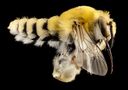
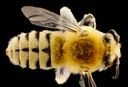
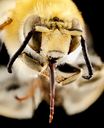
Identification
Habropoda pallida can be distinguished from the closely related Habropoda miserabilis by differences in female composition, specifically in the position of double bonds in hydrocarbon components and their relative proportions. These chemical differences prevent cross-attraction between the . The species is known as the 'white-faced ,' suggesting pale facial markings that may aid visual identification.
Images
Habitat
Occupies sandy dune in desert environments. Documented from the Kelso Dunes in the Mojave National Preserve, where it nests in sandy soils. is synchronized with the blooming of Borrego milkvetch (Astragalus lentiginosus), which serves as the plant for its blister beetle .
Distribution
Found in the Mojave and Sonoran Deserts of south-central California. Distribution records also indicate presence in Central America and North America broadly, though detailed locality records are sparse beyond the well-studied Mojave Desert .
Seasonality
occurs in early spring, making it the first native to emerge on the Kelso Dunes. Adult blister beetles emerge in winter months (January) and feed on plant foliage before bee emergence.
Diet
Females provision nest with pollen. Has been observed collecting pollen from Larrea tridentata (creosote bush).
Host Associations
- Larrea tridentata - pollen sourceFemales provision young with pollen from this plant
- Astragalus lentiginosus - indirect associationBorrego milkvetch blooming synchronizes with ; sole plant of blister beetles at Kelso Dunes
- Meloe franciscanus - Blister beetle larvae mimic female , attach to male bees, transfer to females during mating, and consume nest provisions and likely
Life Cycle
Solitary ground-nesting . Females construct nest burrows in sandy soils and provision with pollen. The nest Meloe franciscanus has a complex : triungulin larvae aggregate on plant stems, release mimicking female bee to attract males, attach to male bees, transfer to females during mating, and are transported to nests where they feed on provisions and likely . larvae remain in nests until emerging as the following winter.
Behavior
Males are attracted to female composed of long-chain hydrocarbons. The exhibits mate-guarding by males after mating. Communication signals vary hydrocarbon double-bond positions and component proportions to maintain species specificity and avoid cross-attraction with .
Ecological Role
of desert plants including Larrea tridentata. Serves as for specialized parasitic blister beetles, representing a documented case of chemical mimicry in a -host system. Contributes to early-season pollination services in Mojave Desert .
Human Relevance
Subject of significant research on chemical and - . Research on this and has informed conservation efforts for native bees, including restoration at sites like the San Francisco Presidio where related species have been reestablished. Studies on this species have contributed to understanding how utility- solar development may impact desert bee biodiversity.
Similar Taxa
- Habropoda miserabilis with overlapping research attention; distinguished by differences in female hydrocarbon profiles, specifically double-bond positions and component proportions. H. miserabilis occurs in coastal sand dunes of Oregon and California rather than desert .
More Details
Chemical Communication Research
Research by Saul-Gershenz and Millar (2006) established that H. pallida uses long-chain hydrocarbons for female sex attraction, with specific positional isomers and blend ratios that differ from H. miserabilis. This work demonstrated that co-opt this communication channel through deceptive chemical mimicry.
Conservation Context
Studies of H. pallida and related desert bees have documented high in the Mojave and western Sonoran region (minimum 114 including six undescribed species), highlighting the biological significance of these landscapes and the importance of regional planning for conservation.
Sources and further reading
- BugGuide
- Wikipedia
- GBIF taxonomy match
- iNaturalist taxon
- NCBI Taxonomy
- Catalogue of Life
- Those Incredible Digger Bees and Their Nest Parasites | Bug Squad
- A Silver Digger Bee in Flight at Bodega Head | Bug Squad
- The Amazing Bee-Parasite Research of Leslie Saul-Gershenz | Bug Squad
- Bees, Parasites and Maybe the End? | Bug Squad
- Why Silver Digger Bees Are Like Gold | Bug Squad
- What's in a Name? Leslie Saul-Gershenz and Norm Gershenz | Bug Squad