
Habropoda miserabilis
(Cresson, 1879)
silver digger bee
Habropoda miserabilis, commonly known as the silver digger , is a solitary ground-nesting bee native to western North America. This was historically abundant in coastal sand dune but declined dramatically by the mid-20th century due to habitat loss from plant encroachment. Recent habitat restoration efforts have enabled recoveries at several sites. The species serves as a for the parasitic blister beetle Meloe franciscanus, which has evolved sophisticated chemical mimicry to exploit the bee's mating system.
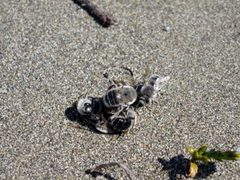
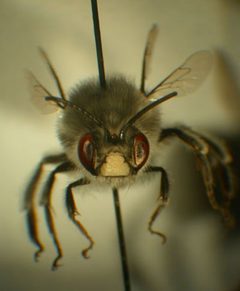
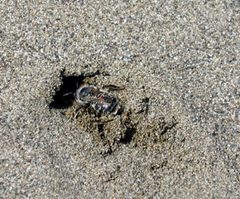
Pronunciation
How to pronounce Habropoda miserabilis: /hæbˈrɒpədə ˌmɪzəˈræbɪlɪs/
These audio files are automatically generated. While they are not always 100% accurate, they are a good starting point.
Identification
have a distinctive silvery or pale covering the and , earning the 'silver digger .' Females carry pollen on scopal hairs located on the hind legs. Males exhibit mate-guarding , remaining with females after mating to prevent additional copulations. The can be distinguished from the Habropoda pallida by differences in female composition, specifically in the position of double bonds and proportions of long-chain hydrocarbon components.
Images
Habitat
Coastal sand dunes and sandy soils. In the San Francisco Presidio, the nests in restored dune areas where non-native vegetation has been removed. have been documented in coastal Oregon at Waldport and in the Mojave Desert region.
Distribution
Western North America, including coastal California (San Francisco Presidio, Bodega Bay, Humboldt Bay area), coastal Oregon, and south-central California. The has been recorded from the coastal sand dunes of Oregon and historically from dunes near Lake Merced in San Francisco.
Seasonality
emerge in spring. In the San Francisco area, the was observed in March 2019. In the Mojave region, is synchronized with the blooming of plants.
Diet
feed on nectar and pollen from mustard, wild radish, and other flowering plants. Larvae consume nest provisions consisting of pollen and nectar stores.
Host Associations
- Meloe franciscanus - Blister beetle larvae produce mimicking female to attract male bees. Larvae attach to males and transfer to females during mating, ultimately reaching bee nests where they consume provisions and likely .
Life Cycle
Solitary ground-nesting . Females construct nest burrows in sandy soils and provision with pollen and nectar. Males emerge before females and patrol for mates. The species is , with active in spring and larvae developing in nests until the following season.
Behavior
Males engage in mate-guarding , remaining positioned on or near females after copulation to prevent rival males from mating. This behavior has been photographed and documented in Oregon . Males are attracted to female composed of long-chain hydrocarbons.
Ecological Role
Important in coastal dune . The contributes to the pollination of native and introduced flowering plants in its . Its presence indicates healthy, functioning sand dune ecosystems with minimal plant cover.
Human Relevance
Subject of conservation interest due to historical declines and recent recoveries following restoration. The has been featured in research on chemical and - . Its rediscovery at the San Francisco Presidio in 2019 demonstrated the effectiveness of ecological restoration for native conservation.
Similar Taxa
- Habropoda pallida with overlapping geographic range in California. Distinguished by differences in female chemistry and preference—H. pallida occurs in Mojave and Sonoran Desert regions while H. miserabilis is primarily coastal.
- Anthophora bomboides stanfordiana mimic that occurs sympatrically at Bodega ; distinguished by different foraging and lack of silvery .
More Details
Chemical Ecology Research
Research by Saul-Gershenz, Millar, and colleagues established that H. miserabilis females use specific blends of long-chain hydrocarbons as sex attractants. The position of double bonds and relative proportions of components vary among closely related Habropoda , serving as a prezygotic isolation mechanism. The nest Meloe franciscanus has evolved -specific blends that precisely match the profiles of local H. miserabilis populations, demonstrating -race formation in the parasite.
Conservation History
The was described from San Francisco dunes near Lake Merced in 1928 and was considered 'all but gone' by the mid-20th century due to urbanization and plant establishment. The 2019 rediscovery at the Presidio followed extensive dune restoration by the Presidio Trust. Similar recoveries have occurred at Bodega Marine Reserve and Lanphere Dunes following ice plant removal.
Sources and further reading
- BugGuide
- GBIF taxonomy match
- iNaturalist taxon
- Catalogue of Life
- A Silver Digger Bee in Flight at Bodega Head | Bug Squad
- Why Silver Digger Bees Are Like Gold | Bug Squad
- Those Incredible Digger Bees and Their Nest Parasites | Bug Squad
- The Amazing Bee-Parasite Research of Leslie Saul-Gershenz | Bug Squad
- Bees, Parasites and Maybe the End? | Bug Squad
- What's in a Name? Leslie Saul-Gershenz and Norm Gershenz | Bug Squad