
Meloe americanus
Leach, 1815
Buttercup Oil Beetle, American Oil Beetle
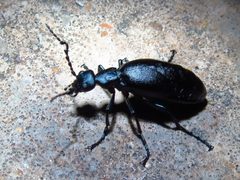
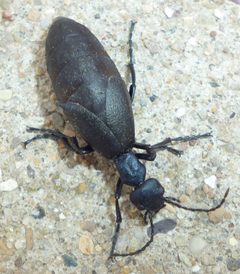
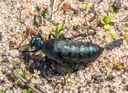
Meloe americanus is a flightless blister beetle native to North America, commonly known as the buttercup oil beetle or American oil beetle. are entirely black with occasional blue metallic iridescence, measuring 7–17 mm in length. The exhibits a complex involving , with triungulin larvae employing to reach nests where they develop as . Adults are active during late autumn through early spring, with peak in December and April. The is notable for its chemical defense: it secretes , a potent blistering agent toxic to mammals at high concentrations.
Pronunciation
How to pronounce Meloe americanus: //ˈmɛloʊ i əˌmɛrɪˈkeɪnəs//
These audio files are automatically generated. While they are not always 100% accurate, they are a good starting point.
Identification
Distinguished from other Meloe by the combination of: entirely black coloration with possible blue metallic sheen (not violet or green); short abbreviated exposing most of the ; flightlessness due to absent hind wings; and male with a bend near the middle versus straight female antennae. M. americanus is one of only two Meloe species occurring in Mississippi, Louisiana, and Alabama, where it overlaps with M. tropicus. It can be separated from M. tropicus by geographic and seasonal patterns: M. americanus is active in late autumn to early spring, while M. tropicus has different seasonal activity.
Images
Appearance
are soft-bodied, entirely black beetles with occasional blue metallic iridescence. Body length ranges from 7 to 17 mm. The are short and abbreviated, leaving much of the exposed; hind wings are absent, rendering adults flightless. The neck region (pronotum) is narrower than the and abdomen, creating a distinct constricted appearance. is present in antennal structure: females possess straight, linear , while males have antennae with a distinct bend near the middle. Both sexes have long legs relative to body size.
Habitat
Inhabits mesic with temperate climates, including lowland terrains such as farms, woodlands, and open grassy areas. Frequently encountered at the bottom of wooded ravines where preferred plants grow abundantly. When not actively foraging or mating, seek shelter under objects including leaves, logs, and rocks. Habitat selection is influenced by food plant availability and proximity to ground-nesting required for larval development.
Distribution
Native to the northeastern United States, with range extending into central and southern regions including Mississippi, Louisiana, and Alabama. One of only two Meloe occurring in the Deep South. Southern distribution is enabled by mild winters and seasonal activity patterns synchronized with flowering forbs that attract . Canadian records exist from Ontario.
Seasonality
emerge from soil between winter and spring, with peak activity in December and April. They forage, mate, and oviposit during this period. Triungulin larvae (first instar) appear in fall, are absent during winter months, and reemerge in spring with peaks in October and April. The coarctate phase (sixth instar) occurs in spring through early summer, completing development in summer through early fall. This autumn–spring activity pattern is unusual among Meloe and enables persistence in regions with mild winters.
Diet
are phytophagous, feeding on flowers, stems, and leaves of herbaceous plants. Primary plant consumed are Ranunculaceae (buttercup family) and Compositae (aster family). Larvae are entomophagous and parasitic, feeding on , eggs and larvae, and provisions (nectar-pollen mixtures) within bee nests.
Host Associations
- Apoidea - Triungulin larvae attach to bees via to reach nests; most commonly observed belong to this superfamily
- Hymenoptera - Other insects in this order have been observed carrying triungulin larvae
- Ranunculaceae - food plantPrimary plant consumed by
- Compositae - food plantPrimary plant consumed by
Life Cycle
Hypermetamorphic with four general stages (, larva, pupa, ) subdivided into nine instars total. Eggs are cylindrical, yellow to deep orange, 0.5–2 mm long, laid in soil cavities excavated by females (~1000 eggs per oviposition). Eggs hatch within 30 days, or up to 130+ days in some cases. Larval stage comprises seven instars: first instar (triungulin) — mobile, climbs foliage, attaches to bees via ; second through fifth instars (first phase) — active feeding within ; sixth instar (coarctate phase) — increasingly inactive and sedentary; seventh instar (second grub phase) — completely inactive. Eighth instar is pupal; ninth instar is adult. Development within bee cells takes 60–90 days.
Behavior
are , remaining under ground objects during daylight and becoming active in dim light or darkness. When exposed to bright light, they immediately seek shelter. Adults are generally solitary and not -prone, likely due to flightlessness limiting movement and small size of preferred food plants restricting feeding site capacity. Adults display of contact, responding with passivity, departure, or kicking when touched. Males initiate all courtship, climbing onto females and engaging in riding and display . Copulation can last up to eight hours. Females excavate soil burrows for oviposition using and legs, then seal the cavity after -laying.
Ecological Role
function as herbivores consuming herbaceous vegetation. Larvae are of ground-nesting bees, potentially regulating . The phoretic relationship between triungulin larvae and wild bees represents a specialized mechanism. production provides chemical defense against . The serves as a -specific in native bee , with documented local adaptations to different bee host species in related Meloe species suggesting complex coevolutionary dynamics.
Human Relevance
Poses agricultural concern due to crop damage from herbivory. Contains , a potent blistering agent toxic to mammals at high concentrations; can be lethal to livestock when beetles are inadvertently consumed in hay. Historical medicinal use of cantharidin (as "Spanish fly") as aphrodisiac and counterirritant, though toxic and potentially fatal. Direct contact with secretions causes skin blistering in humans. Subject of scientific research on chemical , - interactions, and local in host-parasite systems.
Similar Taxa
- Meloe tropicusOverlaps in Mississippi, Louisiana, and Alabama; distinguished by different seasonal activity patterns and subtle morphological differences
- Meloe proscarabaeusEuropean oil beetle with similar abbreviated and flightlessness; distinguished by geographic separation and violet coloration in some
- Meloe violaceusEuropean oil beetle with violet-blue iridescence; distinguished by coloration and geographic range
- Epicauta spp.Other blister beetles with functional wings and different body proportions; distinguished by presence of hind wings and ability to fly
More Details
Phoretic Parasitism Mechanism
Triungulin larvae attach to the base of wings or legs of bees — areas least accessible to — ensuring transport to nests. Upon arrival, larvae consume provisions before eating host or larvae, typically utilizing two or more larvae during development.
Chemical Defense and Mating
is hypothesized to play a role in mating ; high concentrations occur on male and genitalia, with cuticular pores suggesting function. In other Meloidae, cantharidin is transferred as a during mating.
Male-Male Courtship
Males have been observed displaying courtship toward other males when sexually deprived or isolated, suggesting that explicit female recognition is not required to trigger male sexual behavior.
Sources and further reading
- BugGuide
- Wikipedia
- GBIF taxonomy match
- iNaturalist taxon
- Meloidae Holdings | Entomology Research Museum
- The Amazing Bee-Parasite Research of Leslie Saul-Gershenz | Bug Squad
- Ground nesting bees beware of blister beetles - Meloe spp. — Bug of the Week
- Blistering beetles - Meloe spp. — Bug of the Week
- Springing into action – oil beetles and citizen science! - Buglife Blog - Buglife
- Seasonal Activity of Meloe americanus (Coleoptera: Meloidae) in a Mississippi Old-field Habitat