
Nomia melanderi
Cockerell, 1906
alkali bee, Alkali Nomia
Nomia melanderi, commonly known as the alkali , is a solitary ground-nesting bee native to the western United States. It is the world's only intensively managed ground-nesting bee, commercially cultivated for alfalfa pollination. The nests in dense in moist, alkaline soils and exhibits traits that preceded insect sociality, including defense of offspring against and .
Pronunciation
How to pronounce Nomia melanderi: //ˈnoʊ.mi.ə ˌmɛl.ənˈdɛr.i//
These audio files are automatically generated. While they are not always 100% accurate, they are a good starting point.
Identification
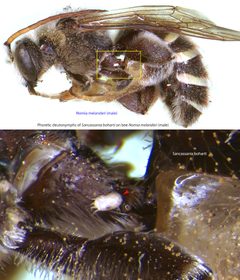
Medium-sized solitary with typical halictid . Females construct individual underground in dense nesting . Distinguished from other Nomia by its specific association with alkaline soils and western North American distribution. Males and females can be differentiated by size dimorphism, with body size negatively correlated with aggression levels in behavioral interactions.
Images
Habitat
Ground-nesting in moist, alkaline soils of arid valleys and basins. Requires specific soil conditions with appropriate hydraulic conductivity and mineral salt composition for successful nest construction. Nests occur in dense . Some isolated utilize hot spring areas in cold climates.
Distribution
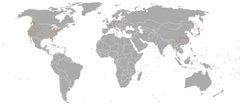
Western United States, including desert and semi-arid desert basins. Native to deserts and semi-arid regions of western North America. Also recorded from Australia (introduced or present).
Seasonality
Nests during midsummer in western United States. activity period coincides with alfalfa bloom period in managed agricultural settings.
Diet
Polylectic pollen collector. Primary wild floral poorly known or non-native. In agricultural settings, heavily utilizes alfalfa (Medicago sativa) as pollen and nectar source.
Life Cycle
Females construct individual underground provisioned with pollen mass before laying. Eggs laid on pollen provision. Larvae develop within cells feeding on stored pollen. Development occurs entirely within underground nest cells.
Behavior
Nests in dense in ground. Females exhibit specific construction and provisioning . Aggression levels modulated by body size and social context: smaller individuals show increased aggression, particularly in mixed-size pairings. Exhibits defensive behaviors against and . Males and females both capable of with foraging range extending into neighboring crop areas.
Ecological Role
Efficient native , particularly of alfalfa seed crops. Second most valuable managed solitary for United States agriculture. Contributes to pollination services in both agricultural and natural through polylectic foraging habits.
Human Relevance
Intensively managed for commercial alfalfa pollination, representing the only successfully managed ground-nesting worldwide. Subject of extensive research on solitary bee , management, and comparative for understanding evolution of social . Management requires specialized knowledge of soil hydrology and mineral composition.
Sources and further reading
- BugGuide
- GBIF taxonomy match
- iNaturalist taxon
- NCBI Taxonomy
- Catalogue of Life
- The Amazing Bee-Parasite Research of Leslie Saul-Gershenz | Bug Squad
- Meadow Grasshopper
- Grasshoppers of Colorado
- Field Guide Selected References
- Hayden Grasshopper
- Grasshoppers of Colorado
- Behavior of the Alkali Bee, Nomia melanderi, within the Nest (Hymenoptera: Halictidae)
- Small Body Size Is Associated with Increased Aggression in the Solitary Sweat Bee Nomia melanderi (Hymenoptera, Halictidae)
- The Extraordinary Alkali Bee, Nomia melanderi (Halictidae), the World's Only Intensively Managed Ground-Nesting Bee
- Draft Genome Assembly and Population Genetics of an Agricultural Pollinator, the Solitary Alkali Bee (Halictidae: Nomia melanderi )
- Draft genome assembly and population genetics of an agricultural pollinator, the solitary alkali bee (Halictidae: Nomia melanderi )