
Nomia
Latreille, 1804
sweat bees, alkali bees
Species Guides
6- Nomia angustitibialis(Canyon Nomia)
- Nomia foxii
- Nomia maneei(Manee's Nomia)
- Nomia melanderi(alkali bee)
- Nomia nortoni(Norton's Alkali Bee)
- Nomia tetrazonata(four-banded nomia)
Nomia is a of sweat bees in the Halictidae, comprising approximately 130 worldwide. These moderate-sized bees are characterized by opalescent bands on the metasoma in many species. They are ground-nesting bees, with most species nesting solitarily and some exhibiting communal nesting where females share a nest entrance but lack or . The genus includes the intensively managed alkali (N. melanderi), which is commercially used for alfalfa pollination in the western United States.
Pronunciation
How to pronounce Nomia: //ˈnoʊ.mi.ə//
These audio files are automatically generated. While they are not always 100% accurate, they are a good starting point.
Identification
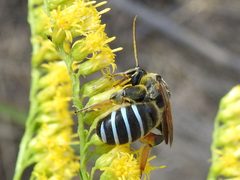
Many Nomia display distinctive opalescent or iridescent bands across the metasoma (). Males of some species, such as N. triangulifera, possess expanded hind tibiae used for clasping females during mating. The can be distinguished from other halictid bees by a combination of moderate body size, ground-nesting habit, and the presence of metasomal banding in numerous species. Species-level identification requires examination of morphological characters including genitalia and punctation patterns.
Images
Habitat
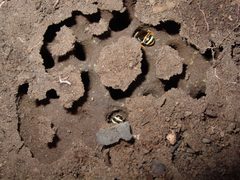
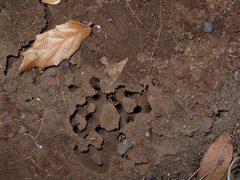
Ground-nesting in soils, with some showing preference for alkaline soils. N. melanderi occupies edge-of-field areas in agricultural landscapes where farmers maintain dedicated ' beds'—sub-irrigated zones reserved for nesting. N. triangulifera has been observed in association with sunflower plants.
Distribution
distribution spanning Africa, tropical Asia, Australia, and North America.
Diet
Females of N. triangulifera use sunflower plants as an exclusive food source. N. melanderi provisions nests with pollen and nectar collected from alfalfa and other floral sources. General feeding habits for the as a whole are not established.
Life Cycle
Males of N. triangulifera emerge before females. Females construct underground , provision them with pollen and nectar, lay directly on the provisions, and larvae develop within the cells. N. melanderi exhibits within nest systems.
Behavior
Males of N. triangulifera patrol sites and fly near plants, producing loud audible buzzes using during courtship. Courtship involves use of fore- and mid-legs, metasoma, and . Females of N. triangulifera rarely mate more than once in captivity; receptive females typically lack sperm in spermathecae, while unreceptive females often contain sperm. N. melanderi exhibits complex nest construction including building, provisioning, and of larvae.
Human Relevance
N. melanderi is the only intensively managed ground-nesting , commercially used to pollinate alfalfa seed crops in the western United States, particularly in Washington State. Farmers maintain sub-irrigated 'bee beds' to optimize nesting conditions, achieving yields of approximately 1,000 pounds of clean seed per acre. Research on N. melanderi has advanced understanding of soil-moisture requirements for ground-nesting bee management.
Similar Taxa
- HabropodaBoth are solitary ground-nesting bees in the superfamily , but Habropoda belongs to Apidae and lacks the opalescent metasomal bands characteristic of many Nomia .
- LasioglossumBoth are halictid sweat bees with ground-nesting habits, but Lasioglossum exhibits greater diversity in social including eusocial , and generally lacks the distinctive opalescent banding of Nomia.
More Details
Communal nesting
While most Nomia are solitary, some exhibit communal nesting where multiple females share a common nest entrance but maintain separate without division of labor into or .
Research significance
N. melanderi serves as a model organism for studying the management of native bees in agricultural systems, with 50 of bees documented in managed beds near Walla Walla, Washington.
Sources and further reading
- BugGuide
- Wikipedia
- GBIF taxonomy match
- iNaturalist taxon
- NCBI Taxonomy
- Catalogue of Life
- The Amazing Bee-Parasite Research of Leslie Saul-Gershenz | Bug Squad
- Nomia-melanderi - Entomology Today
- Nomia melanderi Archives - Entomology Today
- National Pollinator Week is about More than Just Honey Bees
- Behavior of the Alkali Bee, Nomia melanderi, within the Nest (Hymenoptera: Halictidae)
- Pre-copulatory courtship behavior in a solitary bee, Nomia triangulifera Vachal (Hymenoptera: Halictidae)
- Central Effects of Ivermectin in Alleviation of Covid-19-induced Dysauto-nomia