
Nomiinae
Nomiine bees
Genus Guides
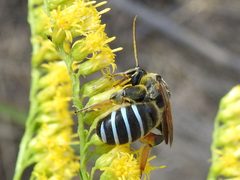
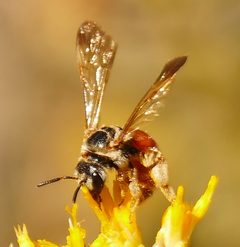
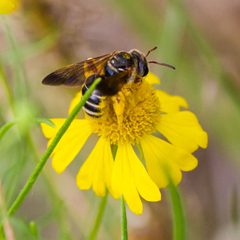
2Nomiinae is a of sweat bees (Halictidae) comprising approximately 11 and at least 550 described . These bees are morphologically diverse, particularly in males, which often exhibit modified hind legs and metasomal sterna. The subfamily has a global distribution with significant diversity in tropical and subtropical regions. Nomiine bees are ground-nesting , with documented nesting in several genera including Nomia, Dieunomia, and Hoplonomia. They exhibit varied social systems ranging from solitary to communal nesting.
Pronunciation
How to pronounce Nomiinae: /ˈnoʊmiˌaɪni/
These audio files are automatically generated. While they are not always 100% accurate, they are a good starting point.
Identification
Males of Nomiinae often display conspicuous morphological modifications including enlarged or modified hind legs and specialized metasomal sterna, features that are frequently diagnostic at the level. Females are generally more conservative in , making -level identification challenging in some genera such as Nomiapis. The is distinguished from other Halictidae by combinations of characters including wing venation, mouthpart structure, and male genitalia morphology. Identification keys to genera are available for regional faunas including Pakistan and India.
Images
Habitat
Nomiine bees occupy diverse terrestrial including agricultural fields, desertic environments with herbs and shrubs, hill torrents, artificial forests, public parks, and roadside vegetation. Nesting occurs in soil substrates, with documented preferences for specific soil types including mixtures of red soil and farmyard manure. The spans sub-tropical arid climates with seasonal activity patterns, as well as temperate and tropical regions.
Distribution
Nomiinae has a global distribution with highest diversity in the Old World tropics and subtropics. Documented regional faunas include: southern Punjab, Pakistan (9 from 4 ); Kerala, India; southern and western India; Oman and the Arabian Peninsula; Spain and southeastern Europe through Central Asia; China; and North America. The is well-represented in the Palaearctic region. Specific genera show varying distributions: Pseudapis is widespread across Africa, the Middle East, and Central Asia; Lipotriches occurs across South and Southeast Asia; Nomia has both Palearctic and Oriental distribution.
Seasonality
Activity patterns vary by and region. In southern Punjab, Pakistan, were collected from October through September with year-round presence. Hoplonomia westwoodi in India shows peak foraging activity from March to June, with maximum activity between 08:00-13:00 hours, though the species remains active throughout the year. In Bengaluru, India, peak occurs June through November. Seasonal timing correlates with floral resource availability in local environments.
Diet
Nomiine bees are polylectic, collecting pollen and nectar from diverse flowering plants. Documented floral include Myrtaceae, Lamiaceae, Portulacaceae, Convolvulaceae, Lythraceae, Meliaceae, Rubiaceae, Solanaceae, Cucurbitaceae, Asteraceae, Fabaceae, Malvaceae, Acanthaceae, Malpighiaceae, Polygonaceae, and Poaceae. Some show marked preference for Solanaceous crops including tomato and eggplant, with observed buzz pollination on these hosts. The Lipotriches includes grass-pollinating species.
Life Cycle
Nesting is documented for several . Hoplonomia westwoodi constructs subterranean nests with turrets on leveled soil surfaces; main shafts extend to approximately 70 cm depth with clustered at varying depths. Nests contain 2-4 cells (mean 2.67) arranged horizontally at the end of straight main tunnels. The completes in approximately 42 days. Nomia tetrazonata exhibits communal nesting. Multiple life stages may be present simultaneously in nest cells. Development occurs in individual cells provisioned with pollen and nectar.
Behavior
Foraging activity peaks during morning hours (08:00-13:00). Buzz pollination has been observed on Solanaceous flowers. Nesting includes construction of soil turrets at nest entrances. Mating behavior involves -specific ; males of some species patrol nesting . Social organization ranges from solitary to communal, with Nomia tetrazonata documented as communal. Nest substrate preferences have been demonstrated experimentally, with bees selecting specific soil mixtures for nesting.
Ecological Role
Nomiine bees function as of wild and cultivated plants. They contribute to pollination of agricultural crops including Solanaceous vegetables. As ground-nesting bees, they participate in soil processes through nest construction. The represents a component of native diversity in agricultural and natural landscapes, with documented value for conservation planning.
Human Relevance
Nomiine bees provide pollination services to agricultural crops, particularly vegetables in the Solanaceae . Hoplonomia westwoodi has been subject to domiciliation studies for potential managed pollination. The has been proposed as a focus for conservation strategies supporting native in agricultural regions of South Asia. Some serve as subjects for taxonomic and ecological research due to their diverse and nesting .
Similar Taxa
- HalictinaeAnother of Halictidae; distinguished by generally smaller body size, different wing venation, and less pronounced male leg modifications in most .
- RophitinaeSister within Halictidae; historically confused with Nomiinae and sharing some ground-nesting habits, but distinguished by mouthpart and male genitalia characters.
More Details
Taxonomic Challenges
Nomiinae suffers from persistent alpha-level taxonomic problems, particularly at the level. The Nomiapis exemplifies these difficulties, with female specimens being especially challenging to delineate. Recent revisionary work has resolved cryptic , such as the separation of Nomiapis valga (restricted to Spain) from Nomiapis caucasica (southeastern Europe to Central Asia). Male genitalia is frequently critical for species identification, with illustrations serving as standard diagnostic tools.
Cleptoparasitism
Eupetersia sp. has been recorded as a in nests of Hoplonomia westwoodi, representing the first documented record of Eupetersia on this .
Sources and further reading
- BugGuide
- Wikipedia
- iNaturalist taxon
- NCBI Taxonomy
- Catalogue of Life
- Bees of subfamily Nomiinae (Hymenoptera, Halictidae) from Southern Punjab, Pakistan
- First report of Lipotriches (Rhopalomelissa) parca (Kohl, 1906) (Halictidae: Nomiinae) from India
- Two new species of Pseudapis Kirby, 1900 (Hymenoptera: Halictidae: Nomiinae) from Oman
- Geographic distribution of halictid bees of the subfamilies Rophitinae and Nomiinae (Hymenoptera, Halictidae) in the Palaearctic
- Review of the Genus Maculonomia Wu (Apoidea: Halictidae: Nomiinae) from India, featuring a new species and new record
- Nesting biology, seasonality and host range of sweat bee, Hoplonomia westwoodi (Gribodo) (Hymenoptera: Halictidae: Nomiinae)
- A checklist of Nomiinae (Hymenoptera, Halictidae) from Kerala, India: new distributional and floral association records
- Bees of the genera Hoplonomia and Crocisaspidia (Halictidae, Nomiinae) of India, with key to species
- Bioecology and Domiciliation of the Alkali Bee, Hoplonomia westwoodi (Gribodo, 1894) (Hymenoptera: Halictidae: Nomiinae) from India
- On the status of Nomiapis valga (Gerstäcker) and its distribution (Hymenoptera, Halictidae, Nomiinae), with an identification key for European Nomiapis
- Bees of grasses, Lipotriches Gerstaecker, Sweat bees, Steganomus Ritsema and Crocisaspidia Ashmead (Halictidae: Nomiinae), with new distribution report from Indian states
- Communal Nesting in a North American Pearly-Banded Bee, Nomia tetrazonata, with Notes on Nesting Behavior of Dieunomia heteropoda (Hymenoptera: Halictidae: Nomiinae)
- Mating behaviour in the bees,Dieunomia heteropodaandNomia tetrazonata, with a review of courtship in Nomiinae (Hymenoptera: Halictidae)
- Figure 2 from: Wood TJ (2025) On the status of Nomiapis valga (Gerstäcker) and its distribution (Hymenoptera, Halictidae, Nomiinae), with an identification key for European Nomiapis. Deutsche Entomologische Zeitschrift 72(1): 85-100. https://doi.org/10.3897/dez.72.153052
- Figure 5 from: Wood TJ (2025) On the status of Nomiapis valga (Gerstäcker) and its distribution (Hymenoptera, Halictidae, Nomiinae), with an identification key for European Nomiapis. Deutsche Entomologische Zeitschrift 72(1): 85-100. https://doi.org/10.3897/dez.72.153052
- A new species and a newly recorded subgenus of Lipotriches Gerstaecker, 1858 (Hymenoptera, Apoidea, Halictidae, Nomiinae) from China.