
Meloe laevis
Leach, 1815
oil beetle
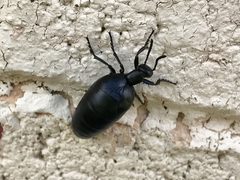
Meloe laevis, commonly known as the oil beetle, is a blister beetle in the Meloidae. It is found across the Caribbean, Central America, and North America. Like other members of the Meloe, it exhibits and is a nest of solitary bees. The has been documented feeding on potatoes and alfalfa, and its consumption by humans has been recorded in Chiapas, Mexico.
Pronunciation
How to pronounce Meloe laevis: //ˈmɛloʊ ˈliːvɪs//
These audio files are automatically generated. While they are not always 100% accurate, they are a good starting point.
Images
Distribution
Caribbean, Central America, and North America. Specific countries with records include Colombia, Rica, Guatemala, Haiti, Honduras, Mexico, Nicaragua, Panama, Dominican Republic, Venezuela, and the United States.
Diet
have been documented feeding on potatoes and alfalfa. Larvae are parasitic, feeding on larvae and nest provisions.
Host Associations
- solitary bees - Larvae (triungulins) are nest . They climb onto flowers, attach to visiting bees, and are transported to nests where they feed on provisions and bee larvae.
Life Cycle
hatch in summer. Larvae are hypermetamorphic: newly hatched triungulins climb onto flowers, attach to visiting bees, and are transported to nests. In the nest, they transform into a -like form, feed on bee provisions and larvae, then pupate and emerge as .
Behavior
When disturbed, may remain upright or fall onto one side, drawing legs toward the body and becoming motionless except for occasional leg flicking. A dark orange liquid exudes from leg joints, and adults may regurgitate when handled. Males court females by stroking and palpating the female's body with their . Females excavate soil cavities for -laying, then backfill and tamp down soil as they exit. Females may lay eggs multiple times in their lives.
Ecological Role
Human Relevance
contain cantharidins, potent irritants that cause skin blistering upon contact. Consumption of adult M. laevis has been documented in Chiapas, Mexico. The can be an agricultural pest on potatoes and alfalfa.
More Details
Taxonomic note
The is placed in the subgenus Treiodous within Meloe. The Wikipedia article contains a misspelling 'Meloe leaevis' that appears in the courtship and interactions sections.
Sources and further reading
- BugGuide
- Wikipedia
- GBIF taxonomy match
- iNaturalist taxon
- NCBI Taxonomy
- Meloidae Holdings | Entomology Research Museum
- The Amazing Bee-Parasite Research of Leslie Saul-Gershenz | Bug Squad
- Ground nesting bees beware of blister beetles - Meloe spp. — Bug of the Week
- Blistering beetles - Meloe spp. — Bug of the Week
- Springing into action – oil beetles and citizen science! - Buglife Blog - Buglife