
Nemognathinae
Laporte, 1840
blister beetles
Genus Guides
2Nemognathinae is a of blister beetles (Meloidae) characterized by highly modified mouthparts, with elongated adapted for feeding on nectar from deep-corolla flowers. The subfamily contains approximately 8 and at least 80-120 described globally, distributed across all continents except New Zealand, eastern Polynesian Islands, and Antarctica. Members exhibit diverse morphological adaptations including sexually dimorphic in some , abbreviated , and reduced hind wings in certain genera. The subfamily is divided into five tribes: Nemognathini, Horiini, Cissitini, Leptopalpini, and Stenoriini.

Pronunciation
How to pronounce Nemognathinae: /nɛmoʊˈnæθɪneɪ/
These audio files are automatically generated. While they are not always 100% accurate, they are a good starting point.
Identification
Distinguished from other Meloidae by the elongated, -like formed from modified , used for nectar feeding. The subfamily can be separated from similar groups by the combination of: (1) elongated maxillary structures (not forming a true food canal but functioning via capillary action along bristles), (2) presence of five tribes with distinct morphological , and (3) in some , abbreviated with reduced hind wings. Molecular identification supported by COI, 16S, 28S, CAD, and ITS2 markers.
Images
Appearance
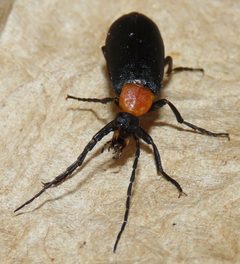
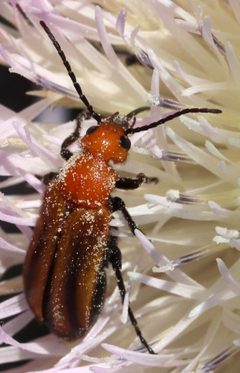
typically possess elongated, () that form a functional for nectar feeding; maxillary length varies among and correlates with flower corolla depth preference. Body form varies from elongate to robust. Some exhibit sexually dimorphic (e.g., Sinostenoria: males with 11 antennomeres, females with 10). Certain display abbreviated and reduced hind wings covered by elytra. Pretarsal claws show distinctive in some genera. Coloration varies widely, with many species exhibiting aposematic coloration typical of chemically defended meloids.
Habitat
Terrestrial across diverse biomes; collected from flowers, vegetation, and associated with nests for parasitic larvae. Type localities include xeric dolomite prairie remnants, dry post oak woodlands, and igneous glades in North America; northern Chinese localities include Beijing/Changping area.
Distribution
Global distribution except New Zealand, eastern Polynesian Islands, and Antarctica. Well-documented from North America (Nearctic), South America (Neotropical), Europe, Asia (including China, Russia, Central Asia), Africa, and Australia. In China, 35+ in 14+ documented across 3 tribes.
Seasonality
active primarily during spring and summer months (May–July in temperate North America; July records from northern China). Phenological periods established for some based on extensive specimen series (e.g., >1000 specimens of Tricrania sanguinipennis, >1100 of T. stansburii).
Host Associations
- bees (Hymenoptera) - larval Cleptoparasitic relationship; first instar larvae seek via
- Osmia lignaria propinqua (Megachilidae) - documented Specific record for Nearctic Tricrania
- flowers with deep corollas - food source feeding facilitated by elongated adapted for nectar extraction
Life Cycle
Behavior
feed on nectar and pollen using specialized elongated ; nectar uptake occurs via capillary action along bristles of the -like structures rather than suction. First instar larvae actively seek , exhibiting phoretic . Some form mating .
Ecological Role
Human Relevance
Some may impact operations through larval cleptoparasitism. occasionally found in large on flowers. Taxonomic interest due to unique morphological adaptations for nectar feeding.
Similar Taxa
- other Meloidae subfamilies (Meloinae, Eleticinae, Tetraonycinae)Nemognathinae distinguished by elongated maxillary forming -like structures; other lack this and typically have standard chewing mouthparts or different modifications
- other flower-visiting beetles (e.g., some Cerambycidae, Scarabaeidae)Superficial similarity in flower association, but Nemognathinae uniquely combine meloid chemical defense with specialized nectar-feeding mouthpart
Misconceptions
Historical texts often described nemognathine mouthparts as 'sucking' with a food canal; scanning electron microscopy and micro-CT studies (Wilhelmi & Krenn 2012) demonstrated that nectar uptake actually occurs via capillary action along bristles of the elongated , not through a true suction canal.
More Details
Molecular phylogenetics
Recent phylogenetic analyses using COI, 16S, 28S, CAD, and ITS2 markers confirm placement of Nemognathinae within Meloidae and resolve tribal relationships. Sinostenoria forms a clade with Longizonitis, Stenoria cf. grandiceps, and Ctenopus cf. persicus within Nemognathini.
Taxonomic history
established by Laporte 1840. Contains five tribes: Nemognathini, Horiini, Cissitini, Leptopalpini, and Stenoriini. Recent revisions include transfer of Oreomeloe from Meloini to Nemognathini based on type examination.
Type genera and species
Type Nemognatha Illiger, 1807. Other genera include Cissites, Gnathium, Hornia, Pseudozonitis, Rhyphonemognatha, Tricrania, and Zonitis in the New World; additional Old World genera include Allendeselazaria, Apalus, Euzonitis, Leptopalpus, Megatrachelus, Stenodera, Sitaris, Stenoria, Synhoria, and various Zonitis-related genera.
Sources and further reading
- BugGuide
- Wikipedia
- iNaturalist taxon
- NCBI Taxonomy
- Catalogue of Life
- Meloidae Holdings | Entomology Research Museum
- Publications | Entomology Research Museum
- Meloidae | Beetles In The Bush | Page 2
- Revision of the nearctic blister beetle genus Tricrania LeConte, 1860 (Coleoptera: Meloidae: Nemognathinae)
- Contributions to the Knowledge of Nemognathinae (Coleoptera: Meloidae) from China.