
Osmia lignaria propinqua
Cresson, 1864
Western Blue Orchard Bee, Blue Orchard Bee, BOB
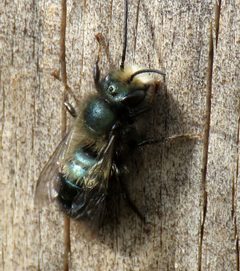
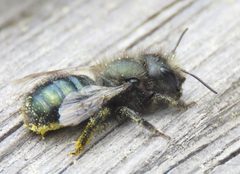
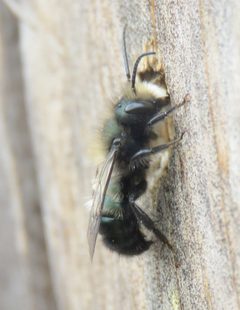
Osmia lignaria propinqua is a solitary, cavity-nesting native to western North America, commonly known as the Western Blue Orchard Bee or BOB. It is a of the blue orchard bee and is valued as a highly efficient of early-blooming fruit trees including almonds, cherries, apples, and plums. Females carry dry pollen on the scopa (hairs) beneath the rather than on leg baskets, and they forage at lower temperatures and for more hours than honey bees. The is managed commercially in orchards, where it is often deployed alongside honey bees to improve cross-pollination through its tendency to move between trees rather than forage systematically on single plants.
Pronunciation
How to pronounce Osmia lignaria propinqua: /ˈɒz.mi.ə lɪɡˈnɛər.i.ə proʊˈpɪŋ.kwə/
These audio files are automatically generated. While they are not always 100% accurate, they are a good starting point.
Identification
Distinguished from honey bees by smaller size, dark metallic coloration, and abdominal pollen-carrying scopa rather than leg corbiculae. Distinguished from other Osmia by geographic range (western North America) and association with early spring orchard pollination systems. Males emerge before females, a trait useful for management timing.
Images
Habitat
Cavity-nesting that uses preexisting holes in wood, reeds, and other tubular natural structures. In managed settings, occupies handcrafted "bee blocks" or "bee condos" with tunnels provided by orchard managers. Nests are partitioned with mud, giving rise to the "."
Distribution
Western North America. Distribution records include California, Oregon, Washington, Utah, and Vermont (though Vermont record may represent eastern O. l. lignaria or misidentification).
Seasonality
Active in early spring, with timed to coincide with bloom of almonds, cherries, apples, and other stone fruits. spend winter in as adults in cocoons. Managed are artificially warmed to synchronize emergence with orchard bloom; heated incubators achieve 60% emergence by day 2 versus 6-8 days in unheated conditions.
Diet
feed on nectar; larvae provisioned with pollen collected by females. In agricultural settings, primarily utilizes pollen from Rosaceae (almond, cherry, apple, plum, pear, peach) and other early spring blooming plants.
Host Associations
- Tricrania stansburyi - Meloid whose larvae consume pollen provisions and developing larvae
- Cacoxenus indagator - Non-native Houdini fly; rates have increased significantly over three years in the Pacific Northwest, posing threat to managed
- Ascosphaera torchioi - Chalkbrood fungus; highest when spores inoculate and at lower rearing temperatures (21°C)
Life Cycle
Solitary with . emerge in early spring, mate, and females construct nests in preexisting cavities. Nests contain multiple separated by mud partitions; each cell is provisioned with pollen and an . Larvae develop through five instars, then pupate and overwinter as adults in cocoons in . Developmental timing and diapause termination are temperature-dependent.
Behavior
Females exhibit "flitting" foraging , moving between trees rather than systematically working single plants, which promotes cross-pollination in orchards. Forages at lower temperatures and for more daily hours than honey bees. Nesting females may delay onset of nesting and reduce nesting duration when exposed to neonicotinoid and resource scarcity.
Ecological Role
Primary of early spring blooming fruit trees and native plants. More efficient per-individual pollinator of almonds and stone fruits than honey bees due to pollen placement and cross-tree movement patterns. Contributes to orchard productivity and maintains pollination services in natural .
Human Relevance
Managed commercially for orchard pollination, particularly almonds in California and early-blooming fruit trees throughout western North America. Several hundred females can pollinate an acre of fruit as effectively as thousands of honey bees. Subject to research on optimal management practices including Hivetop Incubators that use waste heat from hives to synchronize with bloom timing. Threatened by exposure, loss, and introduced .
Similar Taxa
- Osmia lignaria lignariaEastern of the blue orchard bee; distinguished by geographic range (eastern North America versus western)
- Osmia cornifronsHornfaced , another managed Osmia used in orchard pollination; native to Asia, introduced to North America
- Apis mellifera, commonly used alongside BOB in orchards; distinguished by social colony structure, leg-borne , and systematic foraging on single plants
More Details
Management and Research
Recent research has focused on optimizing timing using Hivetop Incubators (HTIs), devices that capture waste heat from hives to warm BOB cocoons. Studies in Utah and Washington demonstrated that HTIs accelerate emergence without adversely affecting honey bee colony health. spillover from managed bees to wild and the impact of multiple stressors ( plus resource limitation) are active research areas. The is the focus of ongoing studies on chalkbrood strain variation and Houdini fly dynamics.
Sources and further reading
- BugGuide
- GBIF taxonomy match
- iNaturalist taxon
- NCBI Taxonomy
- Catalogue of Life
- The Native Bees in the UC Davis Bee Haven | Bug Squad
- Sharing Research About BOB | Bug Squad
- Outstanding Group of UC Davis Graduate Students at ESA Meeting | Bug Squad
- UC Davis Research: A Double Punch to the Blue Orchard Bee | Bug Squad
- A Gathering of Entomologists; UC Davis Graduate Students Are Major Important Part | Bug Squad
- Honey Bee Heat Warms Up Fellow Pollinators for Early-Season Blooms
- Biology of Tricrania stansburyi, a Meloid Beetle Cleptoparasite of the Bee Osmia lignaria propinqua (Hymenoptera: Megachilidae)
- Effects of temperature and host developmental stage on Ascosphaera torchioi Youssef and McManus prevalence in Osmia lignaria propinqua Cresson (Hymenoptera: Megachilidae)