
Osmia lignaria
Say, 1837
blue orchard bee, orchard mason bee, BOB
Species Guides
2- Osmia lignaria lignaria(Eastern Blue Orchard Bee)
- Osmia lignaria propinqua(Western Blue Orchard Bee)
A solitary megachilid native to North America, widely managed for pollination of early spring fruit crops including almonds, apples, and cherries. Distinguished by metallic blue coloration, smaller size than honey bees, and unique mud-nesting . Divided into two by the Rocky Mountains: O. l. propinqua (west) and O. l. lignaria (east).
Pronunciation
How to pronounce Osmia lignaria: /ˈɔz.mi.ə lɪɡˈnɛə.rɪə/
These audio files are automatically generated. While they are not always 100% accurate, they are a good starting point.
Identification
Metallic blue coloration distinguishes from most other native bees. Nests in pre-existing cavities (reeds, holes in wood, keyholes) rather than excavating its own, unlike carpenter bees (Xylocopa). Separated from other Osmia by geographic range and subtle morphological features; O. l. propinqua occurs west of the Rocky Mountains, O. l. lignaria to the east. Olfactory nest recognition —females drag along nest entrance and perform orientation —may aid identification of active nests.
Images
Appearance
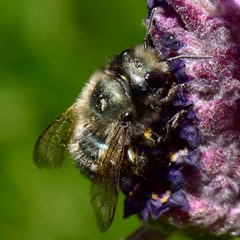
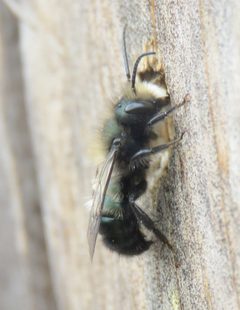
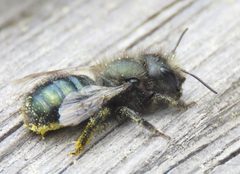
Dark metallic blue to blue-black coloration. Smaller than the (Apis mellifera). Body covered in dense hairs for pollen collection. used to deposit chemical marks and mud during nesting.
Habitat
Requires nesting cavities in narrow holes or tubes: natural reeds, hollow stems, borings in wood, cedar shakes, keyholes, or artificial blocks. Needs access to silty or clayey mud of correct moisture content for construction. Found in orchards, gardens, and natural areas with early spring bloom.
Distribution
Native to North America. Range divided by the Rocky Mountains into two : O. l. propinqua (western subspecies) and O. l. lignaria (eastern subspecies). Does not overwinter in Florida or the Gulf Coast due to insufficient cold winter temperatures required for development.
Seasonality
active in early spring when daytime temperatures reach 14°C (57°F). Males emerge first, followed by females days to weeks later depending on warm weather. Females nest for 4–8 weeks, then die. Larvae develop through summer, pupate, and overwinter as adults in cocoons. broken by winter cold; artificial chilling can advance for orchard management.
Diet
feed on nectar; larvae provisioned with pollen-nectar mass by female parent. Visits flowers nearest the nest rather than traveling miles like honey bees. Can visit 75 flowers per foraging trip.
Life Cycle
Complete with solitary nesting. Female constructs linear series of in pre-existing cavity, each separated by mud partition. Lays single per cell on pollen-nectar provision; female eggs placed toward rear (deeper in cavity), male eggs toward front. Larva hatches, consumes provision, spins cocoon, and pupates. overwinters in cocoon, emerges following spring. Sex ratio biased toward males (approximately 3 males: 1–2 females per cavity).
Behavior
Solitary; each female nests independently. Performs in- orientation dance after selecting nest to memorize visual landmarks. Uses olfactory cues—chemical deposits from abdominal dragging—to recognize own nest. Basks in morning sun to reach flight temperature. Docile; stings only if seriously threatened. Stinger modified as guide. Visits nearest flowers rather than distant sources.
Ecological Role
Important of early spring fruit crops, especially almonds, apples, pears, cherries, plums, and blueberries. More efficient pollinator than honey bees for some native crops. Can forage at cooler temperatures than honey bees. Serves as for multiple including kleptoparasitic mites (Chaetodactylus krombeini), cuckoo bees (Stelis montana), sapygid (Sapyga spp.), and chalcidoid wasps.
Human Relevance
Widely managed commercially for orchard pollination, particularly almonds in California. Beekeepers provide artificial nesting materials (reed tubes, paper straws, wood blocks, " condos") and mud sources. Research subject for studying effects, nutritional stress, and solitary bee conservation. Vulnerable to neonicotinoid (imidacloprid), with multi-generational carryover effects documented. Houdini fly (Cacoxenus indagator), a recently introduced kleptoparasite, poses emerging threat to managed .
Similar Taxa
- Osmia cornifronsAnother managed for orchard pollination; O. lignaria distinguished by metallic blue coloration and earlier spring activity
- Xylocopa spp. (carpenter bees)Both nest in wood; O. lignaria cannot excavate holes and requires pre-existing cavities, while carpenter bees drill their own tunnels
- Apis mellifera (honey bee)Both pollinate orchards; O. lignaria is solitary, smaller, metallic blue, nests in cavities with mud partitions, and forages at cooler temperatures
More Details
Pesticide Sensitivity
Research demonstrates that imidacloprid exposure reduces by 20% through direct effects, with additional 20% reduction from carryover effects across . Combined with floral resource scarcity, reproduction declines 57% with male-biased offspring sex ratio.
Nest Management
Propagation success improved by distributing smaller nest boxes throughout orchard rather than central mass-nesting totes with satellite boxes. Equal distribution yields significantly higher return rates.
Silk Production
Larvae spin silk cocoons during fifth instar; silk fibers can be isolated and mechanically tested without preventing cocoon completion, enabling developmental and nutritional research.
Sources and further reading
- BugGuide
- Wikipedia
- GBIF taxonomy match
- iNaturalist taxon
- NCBI Taxonomy
- Catalogue of Life
- UC Davis Research: A Double Punch to the Blue Orchard Bee | Bug Squad
- Newly Published UC Davis Study: How Imidacloprid Affects Blue Orchard Bees | Bug Squad
- UC Davis Picnic Day: Prime Time for Blue Orchard Bees, Tsetse Flies and Mosquitoes | Bug Squad
- Sharing Research About BOB | Bug Squad
- Outstanding Group of UC Davis Graduate Students at ESA Meeting | Bug Squad
- Exit Seminar on Oct. 18: Clara Stuligross, Ph.D., Is Passionate About Wild Bees | Bug Squad
- Osmia lignaria laboratory rearing protocol v2
- Osmia lignaria laboratory rearing protocol v1
- Olfactory cues and nest recognition in the solitary bee Osmia lignaria
- Emergence Phenology ofOsmia lignariasubsp.lignaria(Hymenoptera: Megachilidae), Its ParasitoidChrysura kyrae(Hymenoptera: Chrysididae), and Bloom ofCercis canadensis
- Host-associated volatiles attract parasitoids of a native solitary bee, Osmia lignaria Say (Hymenoptera, Megachilidae)
- An effective protocol to isolate and mechanically test silk fibers spun by Osmia lignaria v1
- Progeny Density and Nest Availability Affect Parasitism Risk and Reproduction in a Solitary Bee (Osmia lignaria) (Hymenoptera: Megachilidae)
- Effects of temperature and host developmental stage on Ascosphaera torchioi Youssef and McManus prevalence in Osmia lignaria propinqua Cresson (Hymenoptera: Megachilidae)
- Effects of Fungicide and Adjuvant Sprays on Nesting Behavior in Two Managed Solitary Bees, Osmia lignaria and Megachile rotundata
- The Effect of Nest Box Distribution on Sustainable Propagation of Osmia lignaria (Hymenoptera: Megachilidae) in Commercial Tart Cherry Orchards
- Floral microbes provisioned by Osmia lignaria establish in larval food stores, but do not affect bee development or survival.