
Cacoxenus indagator
Loew, 1858
Houdini fly
Cacoxenus indagator is a kleptoparasitic fruit fly native to central and southern Europe that has been introduced to North America. Females lay in the pollen-filled nest of cavity-nesting solitary bees, particularly mason bees (Osmia ). The larvae consume pollen stores intended for larvae, causing host mortality or reduced size. The species is commonly called the "Houdini fly" for its ability to escape sealed nest cells. It poses a significant threat to managed solitary bee in commercial pollination operations.
Pronunciation
How to pronounce Cacoxenus indagator: /ˌkækoʊˈziːnəs ˌɪndəˈɡeɪtɔːr/
These audio files are automatically generated. While they are not always 100% accurate, they are a good starting point.
Identification
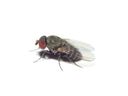
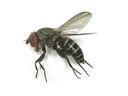
Small brown fly with wing length approximately 2.5 mm. Clear wings and large red . Light gray thoracic coloration provides camouflage when resting near nest entrances. Distinguished from other small flies by its kleptoparasitic association with sealed bee nest and its documented ability to escape through mud partitions.
Images
Habitat
Associated with nests of cavity-nesting solitary bees, particularly in artificial breeding conditions such as reed stem nests, wooden blocks with longitudinal channels, and hotels. Occupies urban and agricultural landscapes where bees are managed.
Distribution
Native to central and southern Europe; recorded in Belgium, Denmark, and other European countries. Introduced to North America, with established in Washington, Oregon, and California in the United States.
Seasonality
Seasonal activity coincides with nest-building activity of bees. Maximum activity recorded between late April and early May, overlapping with the end of the host 's period. Total flight period at least 30 days.
Diet
Larvae feed on pollen stores accumulated by female mason bees for their own offspring. Larvae possess sticky secretions allowing attachment to walls while feeding.
Host Associations
- Osmia cornuta - primary Characteristic ; causes 78% larval mortality or 22% dwarfism in infected
- Osmia lignaria - Blue orchard bee; rates increased significantly over three years in Pacific Northwest monitoring
- Osmia bicornis - Cited in literature
Life Cycle
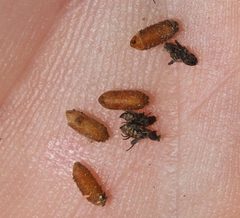
laid in nest during host absence, most commonly 1 or 3 eggs per cell. Larvae feed on pollen stores, then gnaw through nest partitions using moistened secretions to aggregate in cells near the nest exit or vestibule before . emerge after making exit holes in nest plugs. Maximum recorded 46 eggs per female.
Behavior
Exhibits high maneuverability on solid substrates, moving forward, backward, and sideways with equal facility. Females wait 1–2 cm from nest entrances for opportunities to enter during absence. Escapes sideways when approached rather than flying. One female typically occupies a single nest channel until the host seals the nest with an earthen plug. A single fly usually infects multiple nests.
Ecological Role
Human Relevance
Major pest of managed solitary used for orchard pollination, particularly almonds and stone fruits. Poses economic threat to solitary bee industry and orchard managers. Recommended control measures include autumn nest opening to remove larvae and installation of traps during nest-searching periods.
Similar Taxa
Sources and further reading
- BugGuide
- Wikipedia
- GBIF taxonomy match
- iNaturalist taxon
- NCBI Taxonomy
- Catalogue of Life
- Sharing Research About BOB | Bug Squad
- Outstanding Group of UC Davis Graduate Students at ESA Meeting | Bug Squad
- THE NATURE OF DAMAGE TO THE NESTS OF THE OSMIA CORNUTA BEE (LATREILLE, 1805) (HYMENOPTERA: MEGACHILIDAE) BY THE KLEPTOPARASITIC FLY CACOXENUS INDAGATOR LOEW, 1858 (DIPTERA: DROSOPHILIDAE)