
Colletes hyalinus
Provancher, 1888
polyester bee, plasterer bee, cellophane bee
Species Guides
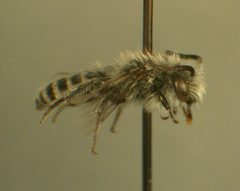
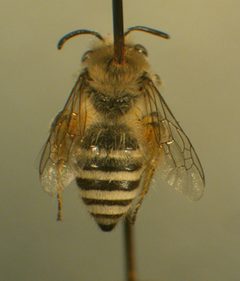
1- Colletes hyalinus gaudialis(polyester bee)
Colletes hyalinus is a solitary ground-nesting in the Colletidae, native to North America. The belongs to a group commonly known as polyester bees or plasterer bees, named for the distinctive cellophane-like lining females create in their underground using secretions from the . Three are recognized: C. h. hyalinus, C. h. gaudialis, and C. h. oregonensis. Like other members of the , this species exhibits protandry, with males emerging before females.
Pronunciation
How to pronounce Colletes hyalinus: /kɔˈliːteɪz haɪˈalɪnəs/
These audio files are automatically generated. While they are not always 100% accurate, they are a good starting point.
Identification
Colletes are challenging to distinguish from similar ground-nesting bees without close examination. Conclusive identification requires observing the forked (bifurcated) (tongue), which is unique to the . Wing venation provides another diagnostic feature: the second recurrent in the forewing is distinctly S-shaped (sinuous) in Colletes, whereas in the similar genus Andrena this vein is relatively straight. Males possess longer than females and lack the scopa (pollen-collecting hairs) on the hind legs. Females have a -shaped in frontal view, contrasting with the more rounded face of Andrena mining bees.
Images
Habitat
Nests in sandy or well-drained soils, often in areas with sparse vegetation including bare patches in lawns, golf course roughs, and open ground. Requires sunny locations for nesting . Soil must be sufficiently friable to allow excavation of burrows.
Distribution
North America. The occurs across the continent with three recognized showing geographic variation: C. h. hyalinus (nominotypical), C. h. gaudialis, and C. h. oregonensis.
Life Cycle
or depending on . Females excavate individual subterranean burrows, creating lined with a waterproof, cellophane-like secretion. Each cell receives a semi-liquid provision of nectar and pollen and a single . Larvae develop through summer and fall, pupating before the following season.
Behavior
Solitary but nests in dense where hundreds to thousands of females may occupy small areas. Males emerge first (protandry) and actively patrol nesting areas seeking females, forming mating balls around receptive females. Both sexes are docile and reluctant to sting. Females emit a citrus-like odor from cephalic glands when handled, containing linalool and other compounds that may function in nest location or mate finding.
Ecological Role
of early spring and autumn flowering plants. The semi-liquid pollen provisions suggest to certain floral resources. Nesting can significantly impact soil structure and nutrient cycling in localized areas.
Human Relevance
Generally beneficial and harmless; large sometimes cause concern but these bees are non-aggressive and rarely sting. Nesting can be discouraged by increasing turf through overseeding and irrigation if necessary. treatment is strongly discouraged due to conservation value of native .
Similar Taxa
- Andrena (mining bees)Similar ground-nesting habit and general appearance; distinguished by straight second recurrent wing and rounded
- Halictus and Lasioglossum (sweat bees)Overlap in size and ground-nesting ; often metallic-colored and have different wing venation and mouthpart structure
- Colletes thoracicusSympatric with similar ; -level identification requires microscopic examination or observation of specific morphological details
- Colletes inaequalisClosely related spring-active ; distinguished by subtle morphological differences requiring expert examination
More Details
Subspecies
Three are recognized: Colletes hyalinus hyalinus Provancher, 1888; C. h. gaudialis Cockerell, 1905; and C. h. oregonensis Timberlake, 1951. These likely represent geographic variants across the ' North American range.
Nesting biology
The cellophane-like lining produced by females is a unique polyester secretion that waterproofs , preserving the liquid food stores for developing larvae. This trait is diagnostic for the and the source of .
Sources and further reading
- BugGuide
- Wikipedia
- GBIF taxonomy match
- iNaturalist taxon
- NCBI Taxonomy
- Catalogue of Life
- An introduction to the Northern Colletes mining bee - Buglife Blog - Buglife
- Boisterous bee-havior of ground nesting bees, Colletes thoracicus — Bug of the Week
- Spring sunshine heralds the appearance of plasterer bees: Colletes — Bug of the Week
- Spring arrives and with it, delightful Plasterer bees: Colletes spp. — Bug of the Week
- Spring sunshine heralds the appearance of plasterer bees, Colletes — Bug of the Week
- Bug Eric: Polyester Bees