
Colletes thoracicus
Smith, 1853
Rufous-backed Cellophane Bee, Rufous-chested Cellophane Bee
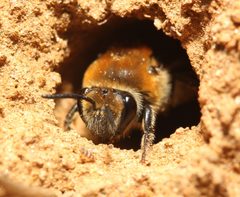
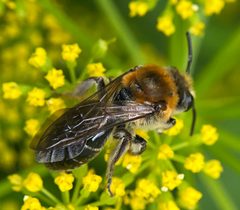
Colletes thoracicus, commonly known as the -backed cellophane bee, is a solitary ground-nesting native to North America. It belongs to the Colletidae, which are known as plasterer or cellophane bees due to their unique nesting . Females construct individual burrows in sandy soils and line the interior chambers with a cellophane-like secretion produced by a gland in their , creating waterproof . This emerges early in spring and is an important native of early-blooming plants.
Pronunciation
How to pronounce Colletes thoracicus: //kəˈliːtiːz θɔːˈræsɪkəs//
These audio files are automatically generated. While they are not always 100% accurate, they are a good starting point.
Identification
Distinguished from other Colletes , particularly the sympatric C. inaequalis and C. validus, by the coloration of the . C. inaequalis typically has a black or dark thorax. Accurate identification often requires examination of morphological details including facial markings and genitalia. The species is part of a complex of three vernal Colletes species that share similar and preferences.
Images
Appearance
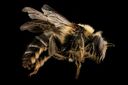
Small to medium-sized with a hairy or metallic appearance. The "-backed" refers to the reddish-brown coloration on the . Like other Colletes , it has a relatively compact body form compared to honey bees and bumble bees. Males and females are similar in general appearance, with males typically smaller and emerging earlier in the season.
Habitat
Sunny locations with sandy soils and thin vegetation. Often found in lawns, golf courses, parks, and other open areas where turf is naturally thin or has become sparse. The bees do not create the thin turf conditions but colonize areas where such conditions already exist. Nesting can be dense, with multiple burrows per square meter in favorable sites.
Distribution
North America. Records extend from the eastern United States west to Kansas and north into southern Canada including Saskatchewan. The overlaps broadly with C. inaequalis across much of its range.
Seasonality
Early spring , with males appearing first (protandry) typically in March to May depending on latitude and weather conditions. Activity peaks on warm, sunny afternoons. The completes its above-ground phase in spring, with larvae developing in burrows through summer and fall.
Diet
feed on nectar from early spring-blooming flowers. Females provision with a semi-liquid mixture of nectar and pollen, primarily collected from flowering trees including tulip tree (Liriodendron tulipifera), Eastern Redbud, and maple .
Life Cycle
Solitary ground-nesting . Females excavate vertical burrows in sandy soil that branch into individual . Each cell is lined with a waterproof, cellophane-like secretion from a in the . Cells are provisioned with a semi-liquid pollen-nectar mixture. Larvae develop through summer and fall, as pre-pupae or pupae in the sealed cells. emerge the following spring. Males emerge first and patrol nesting areas seeking females.
Behavior
Males exhibit territorial patrolling , cruising inches above the ground near nesting to locate emerging females. Multiple males may pursue a single female, creating conspicuous swarming aggregations. When handled, bees emit a citrus-like odor from a cephalic gland; this contains linalool and may function in mate location, nest recognition, or resource finding. Females are extremely reluctant to sting, as each represents a solitary reproductive investment.
Ecological Role
Important early-season native , particularly of trees and shrubs that bloom in spring. Nesting can enhance local pollination services in gardens, orchards, and natural areas. The serves as for blister beetles (Tricrania sanguinipennis), which represents a significant natural enemy.
Human Relevance
Generally beneficial and harmless to humans. Nesting in lawns or recreational areas may cause concern due to swarming male , but the bees are docile and rarely sting. Can be encouraged by maintaining areas of thin turf with sandy soil exposure, or discouraged by overseeding and irrigation to increase grass . Should not be treated with .
Similar Taxa
- Colletes inaequalisSympatric vernal plasterer bee with similar and ; distinguished by dark coloration versus thorax of C. thoracicus
- Colletes validusThird member of the sympatric vernal Colletes complex; shares ground-nesting and spring timing
More Details
Nesting Biology
The "plasterer bee" and "cellophane bee" derive from the unique secretion that females use to line . This substance dries into a transparent, waterproof that protects developing larvae from moisture and fungal .
Pheromone Chemistry
The citrus odor emitted when handled contains linalool and other aromatic compounds. This cephalic gland secretion is one of the best-studied and may function in multiple contexts including , mate finding, and nestmate recognition.
Parasitoid Threat
Colletes thoracicus serves as for the blister beetle Tricrania sanguinipennis, a whose triungulin larvae hitchhike on male bees to reach female nests. Despite this , host persist, though climate disruption of flowering poses greater threats.
Sources and further reading
- BugGuide
- Wikipedia
- GBIF taxonomy match
- iNaturalist taxon
- NCBI Taxonomy
- Catalogue of Life
- Boisterous bee-havior of ground nesting bees, Colletes thoracicus — Bug of the Week
- Archive — Bug of the Week
- Spring sunshine heralds the appearance of plasterer bees: Colletes — Bug of the Week
- Spring arrives and with it, delightful Plasterer bees: Colletes spp. — Bug of the Week
- Spring sunshine heralds the appearance of plasterer bees, Colletes — Bug of the Week
- Bug Eric: The Beetle and the Bee