
Colletes validus
Cresson, 1868
Blueberry Cellophane Bee
Colletes validus is a solitary, ground-nesting in the Colletidae, commonly known as the blueberry cellophane bee. It is a of ericaceous plants, particularly in early spring when Vaccinium bloom. The species exhibits gregarious nesting in sandy soils and is notable for its distinctive elongated, triangular facial structure.
Pronunciation
How to pronounce Colletes validus: /koˈlɛtɛs ˈwalɪdʊs/
These audio files are automatically generated. While they are not always 100% accurate, they are a good starting point.
Identification
The combination of elongated, triangular (exaggerated malar space) and S-shaped 2nd recurrent on the forewing distinguishes C. validus from sympatric . Colletes inaequalis and C. thoracicus, which overlap in range and , lack the distinctive long face.
Images
Habitat
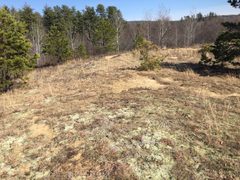
Open sandy soils with sparse vegetation, often near ericaceous plants. Nests on flat ground or south-facing slopes; avoids closed and dense grass. Requires warm soils.
Distribution
Eastern North America: Mid-Atlantic states north through New Hampshire, west through Michigan, with sparse records to Wisconsin and Ontario. Absent from Maine lowbush blueberry fields despite availability. Records from Georgia and Florida now assigned to C. ultravalidus.
Seasonality
; flies early spring. Late March in southern range, three to four weeks later further north. Males emerge precociously, 2–3 weeks before season ends for females.
Diet
Pollen on ericaceous plants with urceolate flowers, including Vaccinium spp., Arctostaphylos uva-ursi, and Gaylussacia baccata. Pollen provisions may contain up to 15% Pinus pollen. visit non-ericaceous plants (Acer rubrum, Prunus spp., Amelanchier spp.) for nectar and supplemental pollen.
Host Associations
- Vaccinium spp. - primary pollen blueberry and related
- Arctostaphylos uva-ursi - pollen bearberry
- Gaylussacia baccata - pollen black huckleberry
- Pinus spp. - incidental pollen sourceup to 15% of provisions
Life Cycle
hatch into larvae that feed on semi-liquid provisions; larvae pupate into . Development proceeds underground through summer. Some may enter before pupating, though completion of development is unconfirmed. Adults overwinter in completed .
Behavior
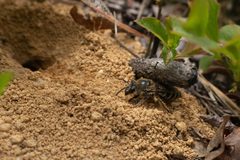
Gregarious nester forming (~5 nests/m²). Males patrol nesting aggregations for mates, locating females via ; mating occurs at nest site. Females may use burrow as nest start. Exhibits natal philopatry. If not yet flowering, females wait at nest entrance and nectar on available flowers. construction occurs primarily at night; provisioning follows next morning.
Ecological Role
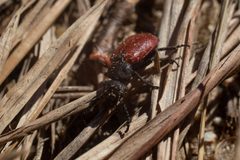
of early spring ericaceous plants. Serves as for blister beetle Tricrania sanguinipennis.
Human Relevance
Potential commercial for blueberry crops; closely matches blueberry bloom. Docile and reluctant to sting; may nest in sandy backyards or footpaths, causing minor concern. Forages for salts from human sweat.
Similar Taxa
- Colletes inaequalisOverlaps in range and ; lacks elongated , visits flowering trees more exclusively
- Colletes thoracicusOverlaps in range and ; lacks elongated
- Colletes ultravalidusRecently described ; previously confused with C. validus in Georgia and Florida records
Misconceptions
The 'blueberry cellophane ' suggests exclusive association with Vaccinium, but the bee forages broadly across ericaceous plants and is not limited to blueberry.
Sources and further reading
- BugGuide
- Wikipedia
- GBIF taxonomy match
- iNaturalist taxon
- Catalogue of Life
- Spring sunshine heralds the appearance of plasterer bees: Colletes — Bug of the Week
- Boisterous bee-havior of ground nesting bees, Colletes thoracicus — Bug of the Week
- Spring arrives and with it, delightful Plasterer bees: Colletes spp. — Bug of the Week
- Spring sunshine heralds the appearance of plasterer bees, Colletes — Bug of the Week
- Bug Eric: The Beetle and the Bee