
Nemognatha
Illiger, 1807
Species Guides
15- Nemognatha bifoveata(Beebalm Blister Beetle)
- Nemognatha cantharidis
- Nemognatha cribraria
- Nemognatha lurida
- Nemognatha lutea
- Nemognatha macswaini
- Nemognatha nemorensis(Eastern Black-headed Nemognatha)
- Nemognatha nigripennis
- Nemognatha nitidula(blister beetle)
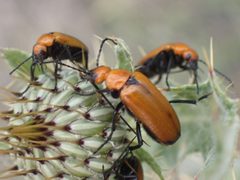
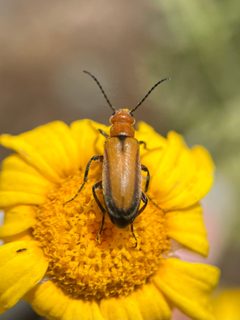
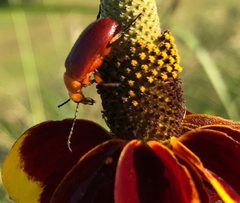
Nemognatha is a of blister beetles ( Meloidae, Nemognathinae) containing at least 20 described . are distinguished by greatly elongated maxillary mouthparts adapted for nectar feeding from flowers with deep corollas. The genus exhibits specialized reproductive : females serve as for first-instar larvae, transporting them to nests of bees where they develop as . This phoretic transport mechanism and nest represent distinctive traits within the Meloidae.
Pronunciation
How to pronounce Nemognatha: //ˌnɛmoʊˈnæθə//
These audio files are automatically generated. While they are not always 100% accurate, they are a good starting point.
Identification
Distinguished from other meloid by the extraordinarily elongated, bristle-covered maxillary that project beneath the body. Similar genera in Nemognathinae (Gnathium, Leptopalpus) also have elongated mouthparts but differ in structure: Gnathium has elongated galeae of different proportions, while Leptopalpus has elongated maxillary palpi rather than galeae. Nemognatha differ from each other primarily in maxillary length, body coloration, and geographic distribution. Separation from Zonitis and Pseudozonitis requires examination of mouthpart structure and male genitalia.
Images
Appearance
possess elongated, thread-like maxillary that extend posteriorly beneath the body, often reaching half the body length or longer. These structures are densely covered with long bristles and function in nectar uptake via capillary action rather than suction. Body form typical of blister beetles with soft, flexible . Coloration variable among ; some exhibit metallic or patterned coloration. remain functional for pollen feeding. Larvae are triungulin-type first instars adapted for phoretic transport.
Habitat
frequent flowering vegetation, particularly plants with deep corollas that match their maxillary length. include prairies, grasslands, chaparral, and open woodlands where bees are active. Larval habitat consists of nests of solitary bees, particularly leaf-cutter bees (Megachilidae) and other ground-nesting or cavity-nesting . In agricultural settings, found in alfalfa, sunflower, and apple orchards where managed pollinators are present.
Distribution
Primarily distributed in the New World. North American documented from the United States (including Oklahoma, Utah, and western states) through Mexico. South American species present in Brazil (Rio Grande do Sul documented) and presumably elsewhere in South America. Old World records include South Africa (N. capensis, N. vansoni) and Europe (N. chrysomelina).
Seasonality
activity coincides with flowering periods of plants and activity periods of host bees. In temperate North America, active primarily late spring through summer (May–August). In subtropical and tropical regions, seasonality likely extended or year-round depending on rainfall and flowering .
Diet
feed on nectar and pollen. Nectar uptake occurs via capillary action along bristle-covered maxillary ; pollen is processed with . Larvae are parasitic, feeding on provisions and developing within nests.
Host Associations
- leaf-cutter bees (Megachilidae) - nest primary group; larvae develop in
- other solitary bees - nest including ground-nesting and cavity-nesting
Life Cycle
First-instar larvae (triungulins) climb onto female beetles and are transported to flowers. During flower visitation, larvae transfer to bees and are carried to nests. Within nests, larvae feed on provisions and developing . Subsequent larval instars and occur within host nests. Developmental details of later instars and pupae poorly documented for most .
Behavior
Mating occurs at specific flower sites (mating site specificity). Females exhibit phoretic transport of first-instar larvae, serving as to nests. are flower visitors, with maxillary length correlating with preferred corolla depth. When disturbed, adults may display slow, deliberate movements typical of chemically defended meloids. Defensive secretion contains , a blistering compound.
Ecological Role
Nest of solitary bees with potential impact on pollination services in agricultural systems. rates in studied reached approximately 7% of . Acts as a natural population regulator of native bees. flower visitation contributes to pollination, though this ecological service is offset by parasitic impacts on populations.
Human Relevance
Potential pest of managed in agricultural settings, particularly alfalfa, sunflower, and apple pollination operations. Low rates (approximately 7% in studied ) suggest limited economic impact, but may influence selection of pollinator for commercial use. content makes toxic if ingested by livestock, though Nemognatha species are generally less problematic than some other meloid (e.g., Epicauta).
Similar Taxa
- GnathiumAlso in Nemognathinae with elongated maxillary ; differs in galeal proportions and body form
- LeptopalpusHas elongated mouthparts, but these are maxillary palpi rather than ; Old World distribution
- ZonitisRelated in Nemognathini with shorter, less modified mouthparts; requires genitalia examination for definitive separation
- PseudozonitisSimilar body form but with reduced maxillary elongation; distinguished by mouthpart structure
Misconceptions
Historical literature describes Nemognatha mouthparts as a '' for 'sucking' nectar, implying a food canal and suction mechanism. This is incorrect: the elongated lack a functional food canal, and nectar transport occurs via capillary action along external bristles, assisted by oral musculature but not by suction.
More Details
Mouthpart biomechanics
Scanning electron microscopy and micro-CT studies (Wilhelmi & Krenn 2012) demonstrated that Nemognatha are solid, bristle-covered structures without a food canal. Nectar uptake occurs through capillary action along the bristle surfaces, representing a distinct evolutionary solution to nectar feeding separate from the suction mechanism of true siphoning insects.
Species diversity
At least 20 described , with North American fauna revised by Enns (1956). Species distinguished by maxillary length, coloration, and male genitalia. Mexican species N. chrysomeloides possesses longer than the body, the extreme of the morphological trend in the .
Agricultural significance
N. nigrotarsata studied as of leaf-cutter bees in Brazilian agriculture. Research indicates low rates (7%) do not preclude commercial use of leaf-cutter bees, but selection for programs should consider local Nemognatha pressure.
Sources and further reading
- BugGuide
- Wikipedia
- GBIF taxonomy match
- iNaturalist taxon
- NCBI Taxonomy
- Catalogue of Life
- Meloidae Holdings | Entomology Research Museum
- Pedantic Sunday: Blister beetles don’t suck | Beetles In The Bush
- First collecting trip of the season! | Beetles In The Bush
- May | 2023 | Beetles In The Bush
- Heliconiidae | Beetles In The Bush
- Mating site specificity, reproduction and vector selection inNemognatha nigrotarsata(Col., Meloidae), a nest parasite of leaf‐cutter bees and other pollinators of crops in Rio Grande do Sul