
Gnathium
Kirby, 1819
Species Guides
5- Gnathium californicum
- Gnathium caviceps
- Gnathium francilloni
- Gnathium minimum(Brown-bordered Sunflower Blister Beetle)
- Gnathium nitidum
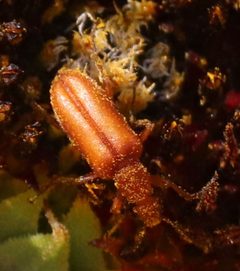
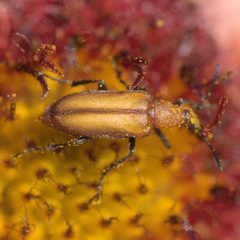
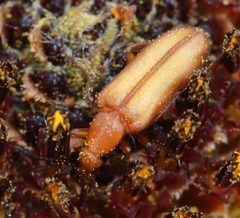
Gnathium is a of blister beetles in the Meloidae, Nemognathinae. The genus comprises approximately 16 described distributed primarily in North America. Members of this genus are characterized by their elongated, nectar-feeding mouthparts, which represent a distinctive within the family. The genus was established by Kirby in 1819.
Pronunciation
How to pronounce Gnathium: /ˈneɪθiəm/
These audio files are automatically generated. While they are not always 100% accurate, they are a good starting point.
Identification
Gnathium can be distinguished from other nemognathine by their elongated maxillary adapted for nectar feeding. Unlike Nemognatha, which also possesses elongated mouthparts, Gnathium species are generally smaller in body size. The mouthparts are densely covered with long bristles and function through capillary action rather than suction. Specific species-level identification requires examination of mouthpart proportions, body size, and genitalia.
Images
Distribution
North America, with recorded from the western and southwestern United States and Mexico. Specific collecting localities include Arizona, California, New Mexico, Texas, and Utah.
Diet
feed on nectar from flowers, utilizing elongated maxillary that transport nectar through capillary action along bristle-covered surfaces. The are used for pollen consumption.
Behavior
are flower visitors, actively seeking nectar sources. The exhibits the hypermetamorphic typical of Meloidae, with triungulin larvae that are likely or in nests, though specific associations for most remain undocumented.
Ecological Role
function as through their flower-visiting . As with other meloids, larvae likely impact native through their parasitic or predatory habits in nests.
Human Relevance
Like other blister beetles, Gnathium contain and are potentially toxic if ingested. They pose a risk to livestock if accidentally consumed in hay or forage. The is of interest to entomologists studying the evolution of nectar-feeding adaptations in Coleoptera.
Similar Taxa
- NemognathaAlso possesses elongated nectar-feeding mouthparts, but Nemognatha generally have longer relative to body size and different body proportions. Gnathium species are typically smaller and more compact.
- LeptopalpusHas elongated mouthparts, but in Leptopalpus the maxillary palpi are elongated rather than the . The feeding mechanism and mouthpart differ significantly.
- ZonitisLacks the highly elongated mouthparts characteristic of Gnathium; Zonitis have more generalized meloid mouthpart structure and are not specialized nectar feeders.
Misconceptions
Older literature incorrectly described the elongated mouthparts of Gnathium as forming a for sucking nectar. Research by Wilhelmi and Krenn (2012) demonstrated that no food canal exists; instead, nectar uptake occurs through capillary action along bristle-covered , not suction.
More Details
Mouthpart morphology
Scanning electron microscopy and micro-CT studies have revealed that Gnathium possesses densely covered with long bristles. These structures do not form a functional unit with a channel, distinguishing their feeding mechanism from true sucking mouthparts found in Lepidoptera or some Hymenoptera.
Species diversity
The contains approximately 16 described , though taxonomic revision may be needed. Documented species include G. californicum, G. caviceps, G. francelloni, G. kanei, G. minimum, G. murrayorum, G. nanulum, G. nitidum, G. politum, G. texanum, and G. vandykei.
Historical taxonomic treatment
The has been included in revisions of North American Nemognathinae, with descriptions and keys provided by MacSwain (1956) and subsequent . The type species is G. minimum (Say).