
Colletes compactus
Cresson, 1868
polyester bee, plasterer bee, cellophane bee
Species Guides
1- Colletes compactus compactus(plasterer bee)
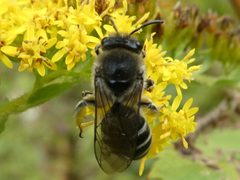
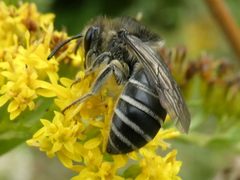
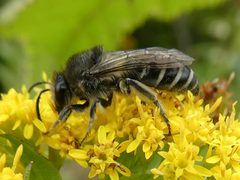
Colletes compactus is a solitary ground-nesting in the Colletidae, native to North America. Like other members of its , it constructs subterranean burrows lined with a distinctive cellophane-like secretion produced by the , earning the "polyester bee" or "plasterer bee." The nests in in sandy soils, with females provisioning individual with a semi-liquid mixture of pollen and nectar. Males emerge before females and actively patrol nesting areas seeking mates.
Pronunciation
How to pronounce Colletes compactus: /kɒˈliːtiːz kəmˈpæktəs/
These audio files are automatically generated. While they are not always 100% accurate, they are a good starting point.
Identification
Colletes , including C. compactus, closely resemble mining bees (Andrena) and larger sweat bees (Halictus, Lasioglossum). Definitive identification requires microscopic examination or observation of subtle characters: Colletes possess a forked, bifurcated tongue () not visible without close inspection; the forewing has three submarginal with the second recurrent distinctly S-shaped (sinuous) rather than straight as in Andrena; and the appears -shaped in frontal view versus round in Andrena. Species-level identification within Colletes generally requires expert examination and is not reliably possible from field observation alone.
Images
Habitat
Sandy soils with sparse vegetation, including bare patches in lawns, golf course roughs, and open ground. Requires well-drained substrate suitable for burrow excavation. Nesting may occupy the same sites year after year if soil conditions remain favorable.
Distribution
North America; confirmed records include Vermont and other parts of the United States. The occurs within the broader range of the Colletes, which exhibits highest diversity in the desert southwest, central plains, and southern New England.
Seasonality
Life Cycle
Solitary lifecycle with subterranean nesting. Females excavate individual burrows up to 26 cm deep, lining with a saliva- secretion that dries to a cellophane-like, waterproof . Each cell receives a semi-liquid provision of pollen and nectar, followed by a single . Larvae develop through summer and fall, pupating to emerge the following spring. Males emerge before females and patrol nesting seeking mates.
Behavior
Nests in dense where hundreds to thousands of females may occupy small areas, creating the impression of sociality despite solitary nesting. Females excavate burrows with mouthparts, accompanied by buzzing that may aid soil loosening. Males exhibit highly aggressive mate-searching , forming "mating balls" around receptive females. Both sexes are docile and reluctant to sting; females risk reproductive failure if they sting and die. Emits a citrus-like odor (containing linalool) from a cephalic gland when handled, possibly functioning in nest-mate recognition or mate location.
Ecological Role
Human Relevance
Beneficial with no significant negative impacts. Nesting in lawns or recreational areas may cause concern due to swarming appearance, but bees are docile and stings are extremely rare. vulnerable to destruction through application, turf improvement, or loss; conservation of nesting sites supports native diversity.
Similar Taxa
- Andrena (mining bees)Similar size, coloration, and ground-nesting habit; distinguished by straight second recurrent wing , round , and lack of cellophane-like lining.
- Halictus and Lasioglossum (sweat bees)Overlap in size and general appearance; sweat bees often exhibit metallic coloration and have different wing venation and nesting .
- Other Colletes speciesExtremely difficult to distinguish without microscopic examination; C. compactus distinguished by subtle morphological characters requiring expert identification.
Sources and further reading
- BugGuide
- Wikipedia
- GBIF taxonomy match
- iNaturalist taxon
- NCBI Taxonomy
- Catalogue of Life
- An introduction to the Northern Colletes mining bee - Buglife Blog - Buglife
- Boisterous bee-havior of ground nesting bees, Colletes thoracicus — Bug of the Week
- Spring sunshine heralds the appearance of plasterer bees: Colletes — Bug of the Week
- Spring arrives and with it, delightful Plasterer bees: Colletes spp. — Bug of the Week
- Spring sunshine heralds the appearance of plasterer bees, Colletes — Bug of the Week
- Bug Eric: Polyester Bees
- Comparative Notes on the Biology and Development of Epeolus compactus Cresson, a Cleptoparasite of Colletes kincaidii Cockerell (Hymenoptera: Anthophoridae, Colletidae)