
Epeolus
Latreille, 1802
variegated cuckoo-bees, cellophane-cuckoo bees
Species Guides
23- Epeolus americanus(American Cellophane-cuckoo Bee)
- Epeolus australus
- Epeolus autumnalis(Autumnal Cellophane-Cuckoo)
- Epeolus axillaris
- Epeolus barberiellus(Barber's Cellophane-cuckoo Bee)
- Epeolus bifasciatus(Two-banded Cellophane-cuckoo Bee)
- Epeolus canadensis(Canadian Cellophane-cuckoo Bee)
- Epeolus carolinus(Carolina Cellophane-cuckoo Bee)
- Epeolus compactus(Compact Cellophane-Cuckoo)
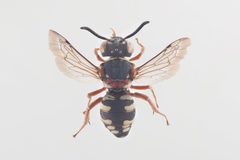
Epeolus is a of medium-sized cleptoparasitic bees comprising approximately 100 described worldwide. All known species are obligate nest (kleptoparasites) of mining bees in the genus Colletes. Females lack the branched pollen-collecting hairs typical of most bees and instead possess specialized abdominal spines used to pierce the cellophane-like nest linings of their . The genus is distinguished by striking black-and-white or black-white-red-yellow integumental patterns formed by short, fat hairs lying flush against the body surface.
Pronunciation
How to pronounce Epeolus: //ɛˈpiː.ələs//
These audio files are automatically generated. While they are not always 100% accurate, they are a good starting point.
Identification
Easily confused with Triepeolus, from which Epeolus is distinguished by generally smaller body size. Within Nomadinae, the combination of abdominal spines in females (used to pierce nest linings), the distinctive flush-lying patterned hairs, and the specific host association with Colletes bees supports identification. The Epeolus tarsalis group and other require examination of genitalic and other subtle morphological characters for definitive identification.
Images
Appearance
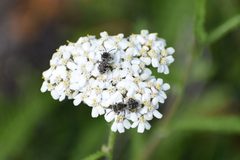
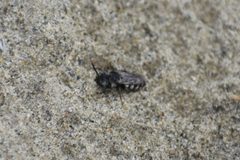
Medium-sized bees, 5.5–10.0 mm in body length. with strong contrasting patterns of black and white on and ; some also display red and yellow markings. These patterns are composed of tiny, short, fat hairs lying flush with the integument rather than projecting branched hairs. Body lacks the dense, branched pilosity typical of pollen-collecting bees, giving a relatively smooth, -like appearance. Females possess spines on the terminal abdominal segments. Males have elongated mouthparts () for nectar feeding.
Habitat
Distribution
distribution with approximately 100 described . Documented from North America (43+ species), the Palaearctic region including Europe, Kyrgyzstan, Tajikistan, Kazakhstan, and China, and other regions worldwide. Distribution records include: Denmark, Norway, Sweden, Vermont (USA), and various US states.
Seasonality
Diet
Host Associations
- Colletes - obligate kleptoparasiteAll known Epeolus parasitize nests of polyester bees in Colletes. Female Epeolus enters nest excavations and lays in unsealed .
Life Cycle
Females locate nests, enter unsealed , and use abdominal spines to pierce U-shaped holes through the cellophane-like secretion lining the cell. are deposited between the layers of this lining, with a small amount of adhesive secretion ensuring attachment. Larvae hatch and consume the host egg or larva, then develop on the pollen provisions stored by the host. Developmental stages follow typical holometabolous pattern: egg, larva, pupa, .
Behavior
Females exhibit -finding oriented toward locating active Colletes nesting . Oviposition involves specialized manipulation of the host's cellophane nest lining using abdominal spines. are often conspicuous near host nesting sites and share floral resources with hosts. Males patrol flowering areas and may exhibit mating behaviors typical of nomadine bees.
Ecological Role
Human Relevance
Rarely encountered by non- due to relative rarity and small size. Some of conservation interest where bees are declining. Subject of taxonomic research; new species continue to be described, including Epeolus attenboroughi named in honor of naturalist David Attenborough.
Similar Taxa
- TriepeolusSimilar appearance and ; Epeolus distinguished by smaller size and specific abdominal spine
- NomadaBoth are cleptoparasitic nomadine bees, but Nomada parasitizes Andrena and other rather than Colletes, and lacks the distinctive flush-lying patterned hairs
- EpeoloidesAnother cleptoparasitic with similar , but parasitizes Macropis bees and has different morphological features
More Details
Etymology
The name 'Epeolus' is probably a diminutive of Epeus/Epeius, the soldier in Greek mythology credited with devising the Trojan Horse, alluding to the deceptive, infiltrating nature of these cleptoparasitic bees.
Taxonomic history
Recent revisions, including Onuferko (2018) for Nearctic , have substantially clarified species boundaries. The Epeolus tarsalis species group was reviewed in 2021, with description of E. mikhailovi from Central Asia.