
Triepeolus
Robertson, 1901
Longhorn-cuckoo bees
Species Guides
23- Triepeolus brittaini(Brittain's Cuckoo Nomad Bee)
- Triepeolus concavus(Concave Longhorn-Cuckoo)
- Triepeolus denverensis
- Triepeolus distinctus
- Triepeolus donatus(Thistle Longhorn-Cuckoo)
- Triepeolus eliseae(Elise's Longhorn-Cuckoo)
- Triepeolus grandis(Great Feather-tongue-Cuckoo)
- Triepeolus grindeliae(cuckoo bee)
- Triepeolus intrepidus(Intrepid Longhorn-Cuckoo)
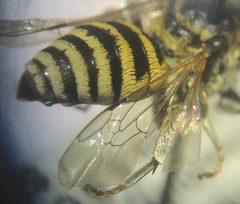
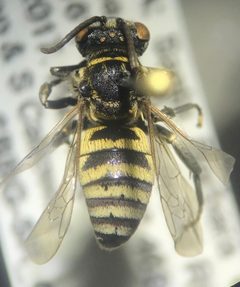
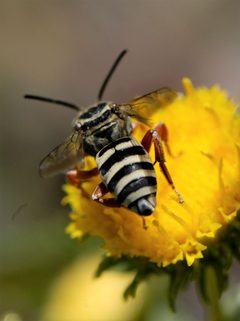
Triepeolus is a of cleptoparasitic (cuckoo) bees in the Apidae, tribe Epeolini. With at least 140 described , it is the second-largest genus of cleptoparasitic apid bees worldwide. Species in this genus are kleptoparasites that lay their in the nests of other bees, primarily long-horned bees in the tribe Eucerini, particularly genera Melissodes and Svastra. The genus has a New World distribution, with its greatest diversity in North and South America, though at least one species occurs in the Palearctic region.
Pronunciation
How to pronounce Triepeolus: /triːɛpˈiːələs/
These audio files are automatically generated. While they are not always 100% accurate, they are a good starting point.
Identification
Triepeolus can be distinguished from related cleptoparasitic by morphological features of the pseudopygidial area in females. In the simplex species group, females possess a trapezoidal or triangular pseudopygidial area with bright, reflective setae and a concave margin. Males typically have long , a trait reflected in the 'longhorn-cuckoo bees.' Identification to species level requires detailed examination of external morphological characters and often benefits from barcode data.
Images
Distribution
New World distribution, with greatest diversity in North and South America. The simplex group is entirely New World. At least one species (T. cecilyae) has been recorded from Chile, representing the first record for that country. A single species has been recorded from Europe (Palearctic region).
Host Associations
- Melissodes - kleptoparasitePrimary in tribe Eucerini
- Svastra - kleptoparasitePrimary in tribe Eucerini; specific association with S. sabinensis documented for T. penicilliferus
- Xenoglossa pruinosa - kleptoparasiteDocumented for T. remigatus; host- interactions characterized by and avoidance
- Caupolicana yarrowi - kleptoparasiteDocumented for T. grandis
- Tetraloniella - kleptoparasite for Palearctic Triepeolus
Life Cycle
Cleptoparasitic. Females enter nests and lay in provisioned by the host . The Triepeolus larva consumes the host's pollen and nectar provisions, often killing the host larva in the process.
Behavior
do not gather pollen or construct nests. Females exhibit parasitic involving rapid visits to nests, preferentially entering while the host is foraging—potentially a strategy to avoid detection. Interactions between T. remigatus and its host X. pruinosa are characterized by minimal aggression and primarily tolerant or avoidant behaviors from both parties. Males have been observed resting on flowers.
Ecological Role
As , Triepeolus function as regulators of their species. They contribute to bee dynamics and may influence host nesting and distribution.
Human Relevance
Males and females may be observed visiting flowers for nectar, making them visible to observers. One was featured in a native mural at the UC Davis Bee Haven as an example of cleptoparasitic bee .
Similar Taxa
- EpeolusSister in tribe Epeolini; both are cleptoparasitic bees with similar . Distinguished by morphological characters and associations (Epeolus primarily parasitizes Colletes).
- SphecodesAnother cleptoparasitic , but in Halictidae (sweat bees) rather than Apidae; similar cuckoo bee lifestyle but different family and associations.
- NomadaLarge of cleptoparasitic bees in Nomadinae, tribe Nomadini; similar cleptoparasitic habit but different tribe and typically different associations (often Andrenidae).
More Details
Subgeneric classification
A 2024 phylogenomic study revised the subgeneric classification of Triepeolus, proposing three new subgenera: Placopyge, Pseudodoeringiella, and Rightmyera. The study also removed Argyroselenis, Pyrrhomelecta, and Trophocleptria from synonymy with Epeolus and recognized them as valid subgenera of Epeolus.
Sources and further reading
- BugGuide
- Wikipedia
- GBIF taxonomy match
- iNaturalist taxon
- NCBI Taxonomy
- Catalogue of Life
- The Native Bees in the UC Davis Bee Haven | Bug Squad
- What Native California Plants Are Best for Attracting Pollinators? | Bug Squad
- Primary Type List | Entomology Research Museum
- Researching the Hedgerows | Bug Squad
- California Poppy: No Nectar, Just Pollen | Bug Squad
- Know Your Native Bees: Here's How! | Bug Squad
- Phylogenomics and biogeography of the cleptoparasitic bee genus Triepeolus Robertson (Hymenoptera: Apidae), with a revised subgeneric classification of Triepeolus and its sister genus, Epeolus Latreille
- A revision of the simplex species group of the cleptoparasitic bee genus Triepeolus Robertson, 1901 (Hymenoptera: Apidae)
- A revision of the South American species of the cleptoparasitic bee genus Triepeolus Robertson, 1901 (Hymenoptera: Apidae)
- Early Nesting Biology of the Bee Caupolicana yarrowi (Cresson) (Colletidae: Diphaglossinae) and Its Cleptoparasite Triepeolus grandis (Friese) (Apidae: Nomadinae)
- Host-parasite interactions between Xenoglossa pruinosa (Apidae: Eucerini) and Triepeolus remigatus (Apidae: Epeolini) are characterized by tolerance and avoidance
- European bees of the genera Epeolus Latreille, 1802 and Triepeolus Robertson, 1901 (Hymenoptera: Apidae: Nomadinae: Epeolini): taxonomy, identification key, distribution, and ecology
- The BeeSvastra sabinensis: Nesting Biology, Mature Oocyte, Postdefecating Larva, and Association withTriepeolus penicilliferus(Apidae: Apinae: Eucerini and Nomadinae: Epeolini)
- Two new species of Epeolini from northern Chile, with the first record of <i>Triepeolus</i> for the country and a key to Chilean species of <i>Doeringiella</i> (Hymenoptera: Apidae)