
Epeolini
cuckoo bees
Genus Guides
2- Epeolus(variegated cuckoo-bees)
- Triepeolus(Longhorn-cuckoo bees)
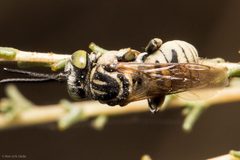
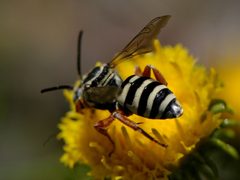
Epeolini is a tribe of cleptoparasitic bees within the Nomadinae. Members are commonly known as cuckoo bees and are obligate that exploit the nest provisions of other for their own offspring development. The tribe comprises five subtribes and approximately ten , including Epeolus, Triepeolus, Odyneropsis, Doeringiella, and Thalestria. Several European species are considered endangered or nearly extinct, while others remain widespread.
Pronunciation
How to pronounce Epeolini: //ˌɛpiˈoʊlɪnaɪ//
These audio files are automatically generated. While they are not always 100% accurate, they are a good starting point.
Identification
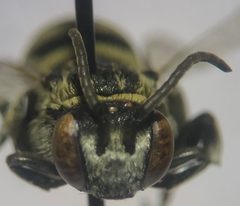
Epeolini typically exhibit -like coloration with yellow and black or red and black banding patterns. Many species have reduced scopal structures on the hind legs compared to non-parasitic bees, reflecting their lack of pollen-collecting . Males often display distinctive facial markings and modified leg structures. Species-level identification requires examination of genitalia and detailed morphological characters; comprehensive identification keys are available for regional faunas including Europe and Chile.
Images
Habitat
Associated with the nesting of . Hosts include ground-nesting bees (Colletes, Tetraloniella, Xenoglossa) and other soil-nesting . Specific requirements are dictated by host nesting preferences, which vary by region and host species.
Distribution
Widespread across multiple continents. In Europe, seventeen of Epeolus and one species of Triepeolus have been recorded, with Epeolus variegatus being the most common and widespread. Several species are restricted to coastal regions or show declining distributions. In the Americas, documented from southwestern USA, México (Jalisco), Chile, and other regions. The Triepeolus has been recorded from northern Chile. Distribution patterns have shifted notably since 1990 for several European species.
Diet
Cleptoparasitic; larvae develop on pollen and nectar provisions stored by bees in their nests. females do not collect pollen or nectar for provisioning.
Host Associations
- Colletes - of Epeolusconfirmed for Epeolus in Europe
- Tetraloniella Ashmead - of Palaearctic Triepeolusconfirmed for Triepeolus in the Palaearctic region
- Xenoglossa pruinosa - of Triepeolus remigatussquash bee; - interactions characterized by and avoidance
- Caupolicana dimidiata Herbst - likely of Doeringiella gigasrecorded from Chile
Life Cycle
Females enter nests to deposit in open . Larvae consume host provisions, killing the host egg or larva. Development occurs within the host cell; timing is synchronized with host . Specific details vary by and host association.
Behavior
- interactions are primarily characterized by tolerant and avoidant rather than aggression. Parasitic females prefer entering host nests while hosts are foraging, suggesting detection avoidance strategies. Nest visits are typically rapid and brief, minimizing exposure and host detection. Host display minimal aggression toward both conspecifics and parasites. These behavioral adaptations optimize parasitic success while reducing conflict.
Ecological Role
of ground-nesting bees. are linked to availability and nesting success. Contributes to understanding of host- in and represents a component of native bee diversity in most regions where hosts occur.
Human Relevance
Several European are of conservation concern. Epeolus fasciatus is nearly extinct, and Epeolus tarsalis has been recently reported only from coastal parts of the Netherlands and Belgium. Epeolus variegatus remains the only common and widespread European species. Declines are likely linked to reductions and loss.
Similar Taxa
- Nomadinae (other tribes)other tribes within the same also contain cleptoparasitic bees; Epeolini distinguished by specific associations and morphological characters including genitalia structure
- Non-parasitic ApidaeEpeolini lack pollen-collecting structures and exhibit -like coloration; can be distinguished by reduced scopa and behavioral differences
Sources and further reading
- BugGuide
- Wikipedia
- iNaturalist taxon
- NCBI Taxonomy
- Catalogue of Life
- The cleptoparasitic bee genus <i>Odyneropsis</i> in México (Hymenoptera, Apidae, Epeolini)
- Host-parasite interactions between Xenoglossa pruinosa (Apidae: Eucerini) and Triepeolus remigatus (Apidae: Epeolini) are characterized by tolerance and avoidance
- European bees of the genera Epeolus Latreille, 1802 and Triepeolus Robertson, 1901 (Hymenoptera: Apidae: Nomadinae: Epeolini): taxonomy, identification key, distribution, and ecology
- The BeeSvastra sabinensis: Nesting Biology, Mature Oocyte, Postdefecating Larva, and Association withTriepeolus penicilliferus(Apidae: Apinae: Eucerini and Nomadinae: Epeolini)
- Two new species of Epeolini from northern Chile, with the first record of <i>Triepeolus</i> for the country and a key to Chilean species of <i>Doeringiella</i> (Hymenoptera: Apidae)