
Triepeolus donatus
(Smith, 1854)
Thistle Longhorn-Cuckoo
Triepeolus donatus is a of cleptoparasitic cuckoo bee in the Apidae. It is found in North America, particularly in the eastern United States and Canada. The species exhibits in wing coloration and length.
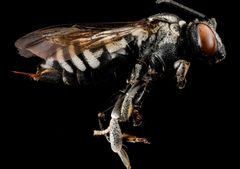
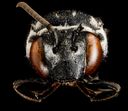
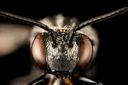
Pronunciation
How to pronounce Triepeolus donatus: //traɪˈɛp.i.oʊ.ləs doʊˈneɪ.təs//
These audio files are automatically generated. While they are not always 100% accurate, they are a good starting point.
Identification
Distinguished from similar Triepeolus by the combination of: black wings in females (reddish in males), always black wing , reddish lower , and specific pattern of gray-white thoracic and abdominal striping. Geographic leg color variation (more reddish in upper Midwest ) may aid identification in those regions.
Images
Appearance
Overall black body with white or grayish-white striping. black with short gray-white hair, denser around base in females. Lower reddish. Antennae black; female segments longer than male. black with grayish-white borders and a white strip, with additional striping. black with gray-white strips. Legs brown to black with silvery-white hairs; in Iowa, Minnesota and North Dakota show more reddish legs. Wings black in females, reddish in males; wing always black.
Habitat
Suburban and urban forest environments. Associated with flowering plants including gumplant (Grindelia camporum).
Distribution
North America: eastern United States (Idaho, Indiana, Iowa, Minnesota, North Dakota, South Carolina, Pennsylvania, Vermont, and other states) and Canada (Ontario).
Host Associations
- Svastra obliqua expurgata - Female cuckoo bees lay in nests
Behavior
Ecological Role
of ground-nesting bees. Functions as a natural control mechanism for .
Similar Taxa
- Triepeolus concavusSimilar cuckoo bee ; distinguished by specific wing coloration and body pattern differences
- Triepeolus punctoclypeusCongeneric with similar cleptoparasitic lifestyle; separated by facial and clypeal punctation patterns
More Details
Sexual dimorphism
The shows pronounced in wing coloration, with females having black wings and males having reddish wings—a reliable field characteristic for distinguishing sexes.
Geographic variation
Leg coloration varies geographically: more reddish in Iowa, Minnesota, and North Dakota compared to the typical brown to black seen elsewhere.
Sources and further reading
- BugGuide
- Wikipedia
- GBIF taxonomy match
- iNaturalist taxon
- NCBI Taxonomy
- Catalogue of Life
- The Native Bees in the UC Davis Bee Haven | Bug Squad
- What Native California Plants Are Best for Attracting Pollinators? | Bug Squad
- Primary Type List | Entomology Research Museum
- Researching the Hedgerows | Bug Squad
- California Poppy: No Nectar, Just Pollen | Bug Squad
- Know Your Native Bees: Here's How! | Bug Squad