
Triepeolus concavus
(Cresson, 1878)
Concave Longhorn-Cuckoo
Triepeolus concavus is a cleptoparasitic in the Apidae. Females lay in the ground nests of bees, particularly sunflower bees (Svastra obliqua expurgata). The lacks pollen-collecting structures (scopa) and relies on stealing food stores provisioned by host bees. It is found in the United States and Mexico.
Pronunciation
How to pronounce Triepeolus concavus: /traɪˈɛpɪələs kɒnˈkeɪvəs/
These audio files are automatically generated. While they are not always 100% accurate, they are a good starting point.
Identification
Distinguished from other Triepeolus by specific morphological features; the specific epithet "concavus" likely refers to a concave structural characteristic. Lacks pollen-collecting structures, distinguishing it from non-parasitic bees. Similar to other Epeolini tribe members but with species-specific diagnostic traits.
Images
Appearance
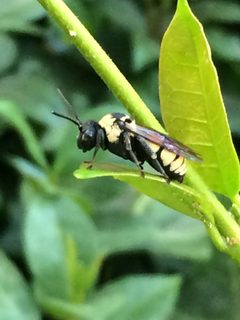
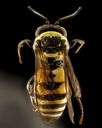
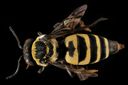
A cuckoo bee with typical longhorn-cuckoo . Males have been observed with long . Lacks scopa (pollen-collecting hairs) on the hind legs, a characteristic of cleptoparasitic bees.
Habitat
Distribution
United States and Mexico. GBIF records indicate presence in Middle America and North America. Documented in California, specifically in Yolo County.
Seasonality
active in summer. Larvae develop underground and emerge the following summer to build nests.
Host Associations
- Svastra obliqua expurgata - kleptoparasiteFemale T. concavus lays in ground nests of this sunflower bee; larvae consume 's pollen stores and kill host larvae
Life Cycle
Females deposit in nests. Larvae hatch and consume the pollen ball collected by the host, then kill and eat the host larvae. Development occurs underground; emerge the following summer.
Behavior
Females are that enter nests to deposit . They wait near nest entrances for host bees to leave before entering. Males have been observed visiting flowers, including blanket flower (Gaillardia).
Ecological Role
Acts as a kleptoparasite on ground-nesting bees, specifically sunflower bees. Represents a natural control mechanism within native .
Human Relevance
Occasionally encountered in urban settings where bees nest, such as near buildings and parking lots. Misidentified by the public as , leading to unnecessary concern. Educational signage has been used to promote conservation.
Similar Taxa
- Triepeolus punctoclypeusCongeneric in the same , distinguished by specific epithet referring to punctate
- Epeolus speciesRelated in tribe Epeolini; T. concavus was historically associated with Epeolus and may be confused with members of that genus
Misconceptions
Public often mistakes this for a due to its and appearance, leading to calls for extermination. It is a native, beneficial insect that poses minimal sting risk.
More Details
Conservation Status
Not formally assessed; dependent on for survival
Research Significance
Documented in UC Davis research on native and hedgerow restoration; used in public education about native bee diversity
Sources and further reading
- BugGuide
- Wikipedia
- GBIF taxonomy match
- iNaturalist taxon
- NCBI Taxonomy
- Catalogue of Life
- Know Your Native Bees: Here's How! | Bug Squad
- You Can Take That to the Bank! | Bug Squad
- The Native Bees in the UC Davis Bee Haven | Bug Squad
- What Native California Plants Are Best for Attracting Pollinators? | Bug Squad
- Primary Type List | Entomology Research Museum
- Researching the Hedgerows | Bug Squad