
Triepeolus grindeliae
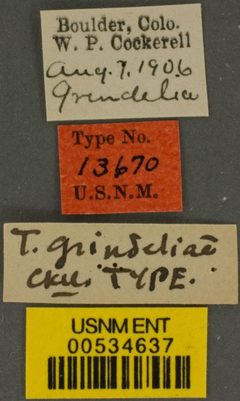
Cockerell, 1907
cuckoo bee
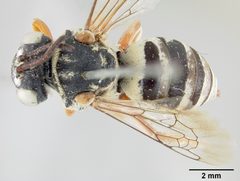
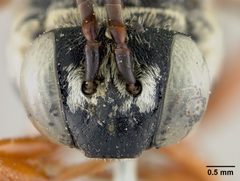
Triepeolus grindeliae is a of cuckoo bee in the Apidae, described by Cockerell in 1907. As a member of the cleptoparasitic Triepeolus, it does not construct its own nests but instead lays in the nests of bees, typically in the family Apidae. The species is found in North America. The specific epithet "grindeliae" suggests a possible association with plants in the genus Grindelia (gumweeds), which may serve as a nectar source or indicate host .
Pronunciation
How to pronounce Triepeolus grindeliae: /traɪˈɛp.iː.əl.əs ˈɡrɪn.dɛl.i.aɪ/
These audio files are automatically generated. While they are not always 100% accurate, they are a good starting point.
Identification
Triepeolus grindeliae can be distinguished from other Triepeolus by specific morphological features, though detailed diagnostic characters require examination of . Members of Triepeolus generally exhibit the characteristic cuckoo bee : relatively hairless bodies with bold black and white or yellow banding patterns, reduced scopae (pollen-collecting structures) in females, and modified body shapes adapted for entering nests. Identification to species level typically requires examination of male genitalia and other subtle morphological characters.
Images
Habitat
The preferences of Triepeolus grindeliae are not well documented. Based on the specific epithet and known of related , it likely occurs in open habitats where its bees and Grindelia plants are present, including prairies, grasslands, and open woodlands in western North America.
Distribution
North America. The has been recorded in the western United States, with specific locality data tied to historical collection records.
Host Associations
- Grindelia - probable nectar sourceThe specific epithet suggests association with gumweed plants, which are common in western North American prairies and provide nectar for bees.
Life Cycle
As a cleptoparasitic (cuckoo) , Triepeolus grindeliae does not construct its own nest or provision with pollen and nectar. Females enter nests of bees (likely Epeolus or related in the Epeolini) and deposit in cells. The resulting larvae consume the host's provisions and typically kill the host larva.
Behavior
Cleptoparasitic is the defining trait of this . Females are known to seek out active nests, often detecting them through chemical or visual cues. They typically enter nests when the host female is absent, deposit quickly, and depart without provisioning.
Ecological Role
As a , Triepeolus grindeliae functions as a natural regulator of its . While individual host larvae are killed, this maintains ecological balance by preventing host population overgrowth and ensuring resource availability across the bee .
Similar Taxa
- Triepeolus lunatusSimilar size and coloration pattern; distinguished by male genitalia and specific associations.
- Epeolus speciesRelated cleptoparasitic bees in the same tribe Epeolini; Epeolus typically parasitize Colletes bees and may differ in body proportions and facial markings.
- Nomada speciesAnother of cuckoo bees in Nomadinae with similar black-and-white or yellow banded appearance; distinguished by wing venation details and antennal structure.
More Details
Taxonomic history
Described by Theodore Dru Alison Cockerell in 1907, this has received limited modern taxonomic attention. The Triepeolus was historically confused with Epeolus, but molecular and morphological studies have clarified their distinctiveness. Triepeolus grindeliae is part of a diverse North American radiation of cleptoparasitic bees.
Conservation status
No formal conservation assessment exists for this . Like many native bees, it may be vulnerable to loss, exposure, and declines in , though specific threats remain undocumented.
Sources and further reading
- BugGuide
- Wikipedia
- GBIF taxonomy match
- iNaturalist taxon
- Catalogue of Life
- The Native Bees in the UC Davis Bee Haven | Bug Squad
- What Native California Plants Are Best for Attracting Pollinators? | Bug Squad
- Primary Type List | Entomology Research Museum
- Bug Eric: White Prairie Clover: An Awesome Blossom
- Evidence for Biodiversity Insurance Hypothesis: More Species Are Indeed Beneficial
- insect collection | Beetles In The Bush | Page 3