
Triepeolus lunatus
(Say, 1824)
Lunate Longhorn-cuckoo Bee, cuckoo bee
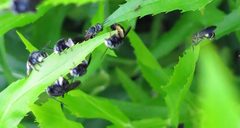
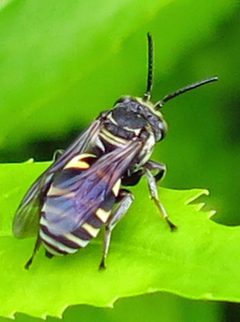
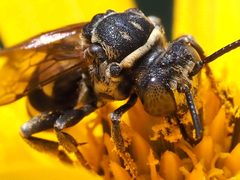
Triepeolus lunatus is a cleptoparasitic in the Apidae, commonly known as the Lunate Longhorn-cuckoo Bee. It occurs across North America from Canada to northern Mexico, and has been observed in Central America. The inhabits forest edges and meadows, where it parasitizes nests of bees. As a member of the simplex species group, females possess a trapezoidal or triangular pseudopygidial area with bright, reflective setae and a concave margin.
Pronunciation
How to pronounce Triepeolus lunatus: /traɪˈɛpiələs luːˈneɪtəs/
These audio files are automatically generated. While they are not always 100% accurate, they are a good starting point.
Identification
Triepeolus lunatus belongs to the simplex group, characterized by females with a trapezoidal or triangular pseudopygidial area bearing bright, reflective setae and a concave margin. The species epithet "lunatus" (meaning crescent or moon-shaped) likely refers to distinctive markings. Identification to species level within Triepeolus requires examination of subtle morphological characters including facial markings, integumental sculpturing, and male genitalia; has been used to help establish species limits in recent revisions.
Images
Habitat
Forest edges and meadows.
Distribution
North America from Canada to northern Mexico; also recorded from Central America.
Behavior
Cleptoparasitic (cuckoo bee) : females lay in the nests of bees, with larvae consuming the host's food provisions.
Ecological Role
Similar Taxa
- Triepeolus simplexConvergent cleptoparasitic and shared membership in the simplex group; requires detailed examination of pseudopygidial area shape and setal patterns for separation.
- Epeolus speciesHistorically confused with Triepeolus; both are cleptoparasitic bees with similar body plans, but differ in structural details of the scutellum and axillae.
Sources and further reading
- BugGuide
- Wikipedia
- GBIF taxonomy match
- iNaturalist taxon
- Catalogue of Life
- The Native Bees in the UC Davis Bee Haven | Bug Squad
- What Native California Plants Are Best for Attracting Pollinators? | Bug Squad
- Primary Type List | Entomology Research Museum
- Meloidae Holdings | Entomology Research Museum
- Encyrtid Holdings | Entomology Research Museum
- Researching the Hedgerows | Bug Squad
- A revision of the simplex species group of the cleptoparasitic bee genus Triepeolus Robertson, 1901 (Hymenoptera: Apidae)