
Triepeolus simplex
Robertson, 1903
cuckoo bee
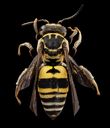
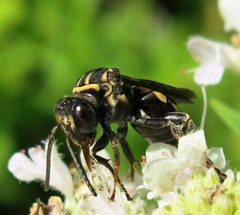
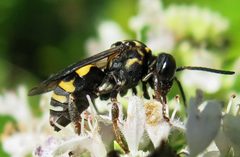
Triepeolus simplex is a cleptoparasitic in the Apidae, described by Robertson in 1903. It belongs to the simplex species group, characterized by females possessing a trapezoidal or triangular pseudopygidial area with bright, reflective setae and a concave margin. As a cuckoo bee, it does not construct nests or collect pollen but instead parasitizes the nests of other bee species. The species occurs in North America and is part of an entirely New World group of Triepeolus species.
Pronunciation
How to pronounce Triepeolus simplex: /traɪˈɛpiːələs ˈsɪmpleks/
These audio files are automatically generated. While they are not always 100% accurate, they are a good starting point.
Identification
Females of the simplex group, including T. simplex, can be distinguished by a trapezoidal or triangular pseudopygidial area on the bearing bright, reflective setae with a concave margin. Species-level identification within the group requires detailed morphological examination using the diagnostic keys provided in the 2024 revision.
Images
Distribution
North America; records include Vermont, United States. The simplex group as a whole is distributed across the New World (North and South America).
Life Cycle
Cleptoparasitic. Lacks pollen-collecting structures; females deposit in nests where larvae consume host provisions.
Behavior
As a , females locate and enter nests of to lay . The species does not construct nests or provision .
Similar Taxa
- Other Triepeolus speciesMembers of the simplex group share the distinctive female pseudopygidial area ; differentiation requires examination of specific setal patterns and other subtle morphological characters.
- Other Nomadinae cuckoo beesShare cleptoparasitic lifestyle but differ in abdominal , particularly the structure of the pseudopygidial area in females.
More Details
Taxonomic revision
The simplex group was revised in 2024 using integrative (morphological, biogeographic, and barcode data), recognizing 18 valid species and establishing clearer species limits for T. simplex and related .
Sources and further reading
- BugGuide
- Wikipedia
- GBIF taxonomy match
- iNaturalist taxon
- NCBI Taxonomy
- Catalogue of Life
- Grasshoppers of Colorado
- Grasshoppers of Colorado
- List of Species Fact Sheets| Grasshoppers of Wyoming and the West
- Grasshoppers of Colorado
- Grasshoppers of Colorado
- Monday Moth – Trichaeta pterophorina | Beetles In The Bush
- A revision of the simplex species group of the cleptoparasitic bee genus Triepeolus Robertson, 1901 (Hymenoptera: Apidae)