
Epeolus bifasciatus
Cresson, 1864
Two-banded Cellophane-cuckoo Bee
Epeolus bifasciatus is a cleptoparasitic in the Apidae, commonly known as the Two-banded Cellophane-cuckoo Bee. As a member of the Epeolus, it parasitizes nests of polyester bees in the genus Colletes, specifically targeting Colletes latitarsis. The is distributed across Central America and North America.
Pronunciation
How to pronounce Epeolus bifasciatus: /ɛˈpiːələs baɪˌfæsɪˈeɪtəs/
These audio files are automatically generated. While they are not always 100% accurate, they are a good starting point.
Identification
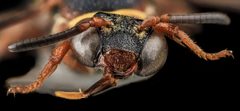
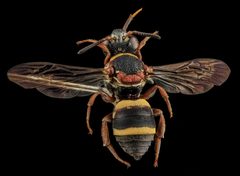
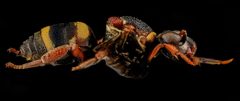
As a cuckoo bee in the Epeolus, E. bifasciatus likely lacks the dense branched hairs typical of pollen-collecting bees, giving it a -like appearance. Members of Epeolus typically possess short black, white, red, and yellow hairs arranged in distinctive patterns. The specific epithet 'bifasciatus' suggests two banded markings, though this requires verification. Definitive identification requires comparison with the Colletes latitarsis and other Epeolus species in the same geographic range.
Images
Habitat
Associated with the nesting of its , Colletes latitarsis. Polyester bees in the Colletes typically nest in underground burrows in open, sandy, or sparsely vegetated soils.
Distribution
Central America and North America. GBIF records confirm presence in Middle America and North America.
Host Associations
- Colletes latitarsis - kleptoparasiteEpeolus bifasciatus is a known of this . The female cuckoo bee lays in the host's nest; upon hatching, the larva kills the host egg or larva and consumes the pollen stores.
Life Cycle
As a cleptoparasitic , females lay in the nests of bees. Larvae hatch and destroy the host's egg or larva, then feed on the pollen provisions collected by the host female. emerge from host nests. Specific developmental timing relative to host is not documented.
Behavior
Kleptoparasitic (nest-parasitic) . Females locate and enter nests to deposit . Does not construct nests or collect pollen.
Ecological Role
Acts as a control on its , Colletes latitarsis. As a , it occupies a higher than its host within .
Similar Taxa
- Other Epeolus speciesMultiple Epeolus occur in North America and may overlap in distribution. Accurate identification requires examination of morphological details and associations.
- Nomada speciesAnother large of cuckoo bees in Apidae with similar cleptoparasitic and -like appearance. Distinguished by taxonomic characters and typically different associations (often Andrena rather than Colletes).
More Details
Taxonomic note
The was described by Cresson in 1864. The Epeolus was revised for Nearctic species north of Mexico by Onuferko (2018), though specific details for E. bifasciatus were not extracted from this source.