
Colletes latitarsis
Robertson, 1891
broad-footed cellophane bee
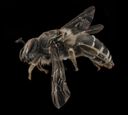
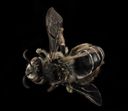
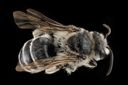
Colletes latitarsis, known as the broad-footed cellophane bee, is a solitary in the Colletidae. Like other members of its , it is a ground-nesting bee that constructs burrows lined with a cellophane-like secretion. The species occurs in North America, with documented presence in the northeastern United States including Vermont. As a member of the Colletes genus, it shares the characteristic forked tongue and cellophane bee with related species.
Pronunciation
How to pronounce Colletes latitarsis: /kɒˈliːtiːz læˌtɪˈtɑːrˌsɪs/
These audio files are automatically generated. While they are not always 100% accurate, they are a good starting point.
Identification
Specific identification characters for C. latitarsis are not documented in available sources. Members of the Colletes can be distinguished from similar mining bees (Andrena) and sweat bees (Halictus, Lasioglossum) by microscopic features: the second recurrent in the forewing is distinctly S-shaped (sinuous) rather than relatively straight, and the tongue is forked at the tip. Colletes have a -shaped in frontal view, while Andrena has a more rounded face. Males lack the scopa (pollen-collecting hairs) on the hind legs present in females and have longer . Species-level identification within Colletes typically requires microscopic examination.
Images
Habitat
Based on -level characteristics, ground-nesting in sandy soils with thin vegetation. Nesting can occur in lawns, parks, golf courses, and other open areas with suitable soil conditions. Prefers sunny locations.
Distribution
North America; documented in Vermont, United States. The broader distribution within North America is not precisely defined in available sources.
Similar Taxa
- Colletes inaequalisAnother early spring plasterer bee with similar nesting and appearance; both are ground-nesting and form
- Colletes thoracicusSympatric vernal plasterer bee with similar ground-nesting and cellophane-lined burrows; distinguished by subtle morphological differences requiring microscopic examination
- Andrena spp.Mining bees that share ground-nesting habit and general appearance; distinguished by straight second recurrent wing and rounded shape
- Halictus spp.Sweat bees that can appear similar in size and ground-nesting ; distinguished by wing venation and tongue structure
More Details
Taxonomic Note
The iNaturalist record lists this as a 'complex' rather than a , suggesting potential taxonomic uncertainty or the presence of cryptic species within this group.
Sources and further reading
- BugGuide
- Wikipedia
- GBIF taxonomy match
- iNaturalist taxon
- NCBI Taxonomy
- Catalogue of Life
- An introduction to the Northern Colletes mining bee - Buglife Blog - Buglife
- Boisterous bee-havior of ground nesting bees, Colletes thoracicus — Bug of the Week
- Spring sunshine heralds the appearance of plasterer bees: Colletes — Bug of the Week
- Spring arrives and with it, delightful Plasterer bees: Colletes spp. — Bug of the Week
- Spring sunshine heralds the appearance of plasterer bees, Colletes — Bug of the Week
- Bug Eric: Polyester Bees