
Epeolus barberiellus
Cockerell, 1907
Barber's Cellophane-cuckoo Bee
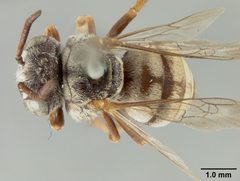
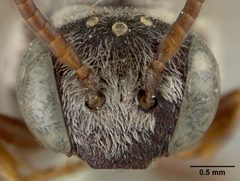
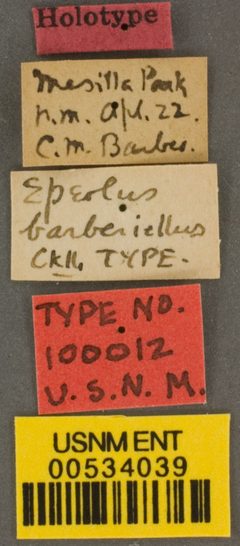
Epeolus barberiellus is a of cuckoo bee in the Apidae, first described by Cockerell in 1907. As a member of the Epeolus, it is a that lays its in the nests of bees, primarily species in the genus Colletes (cellophane bees). The species is known from North America, though specific details about its distribution, abundance, and ecological relationships remain poorly documented compared to better-studied .
Pronunciation
How to pronounce Epeolus barberiellus: /ɛˈpiːələs bɑːrˈbɛriˌɛləs/
These audio files are automatically generated. While they are not always 100% accurate, they are a good starting point.
Identification
Epeolus barberiellus can be distinguished from other Epeolus by the pattern of short, often brightly colored hairs (black, white, red, and yellow) that form distinctive markings on the body. Like other cuckoo bees, it lacks the dense, branched hairs typical of pollen-collecting bees, giving it a more -like appearance. Males possess elongated mouthparts () for accessing nectar. Accurate identification to species level typically requires examination of microscopic morphological features, particularly of the male genitalia and female scutellar punctation patterns.
Images
Habitat
Distribution
North America. Specific locality records are sparse in the provided sources.
Host Associations
Ecological Role
Similar Taxa
- Epeolus attenboroughiBoth are North American Epeolus with similar cleptoparasitic and general body plan; distinguished by specific hair pattern arrangements and genitalic
- Epeolus minimusOverlapping distribution and use; E. barberiellus typically larger with different abdominal banding patterns
- Nomada speciesSimilar cuckoo bee appearance and , but Nomada parasitize different groups (primarily Andrena) and typically have more elongated bodies with different wing venation
More Details
Taxonomic context
Epeolus barberiellus is one of approximately 43 recognized Epeolus in North America. The Epeolus is part of the tribe Epeolini within the Nomadinae, a diverse group of cuckoo bees. The specific epithet 'barberiellus' likely honors an individual named Barber, though the exact etymology is not documented in the provided sources.
Conservation status
No formal conservation assessment is available for this . Like many rare cleptoparasitic bees, it is likely underdetected due to its small size (typical Epeolus range 5.5–10.0 mm), rarity relative to , and lack of distinctive pollen-collecting that would make it conspicuous to casual observers.