
Epeolus minimus
(Robertson, 1902)
Least Cellophane-cuckoo Bee
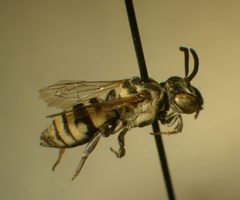
Epeolus minimus is a small cleptoparasitic in the Apidae, commonly known as the Least Cellophane-cuckoo Bee. As a member of the cuckoo bee Epeolus, it invades the nests of bees to lay its , relying on host-collected pollen provisions rather than gathering its own. The is native to North America and has been documented in the northeastern United States, including Vermont. Like other Epeolus species, it lacks the branched body hairs typical of pollen-collecting bees, giving it a -like appearance.
Pronunciation
How to pronounce Epeolus minimus: /ɛˈpiːoʊləs ˈmɪnɪməs/
These audio files are automatically generated. While they are not always 100% accurate, they are a good starting point.
Identification
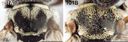
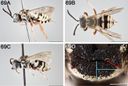
Distinguished from other Epeolus by specific morphological characters detailed in taxonomic revisions. The species epithet 'minimus' suggests relatively small size compared to . Identification to species level requires examination of diagnostic features such as hair pattern, integumental coloration, and male genitalia structure. Distinguished from bees in the Colletes by the absence of scopal hairs for pollen transport and the presence of more pronounced color banding patterns.
Images
Appearance
Small-bodied with reduced compared to pollen-collecting bees. Lacks the dense, branched hairs characteristic of most bees, resulting in a relatively smooth, -like appearance. Possesses short black, white, red, and yellow hairs that form distinct color patterns on the body. Body length falls within the typical range for Epeolus (approximately 5.5–10.0 mm).
Habitat
Distribution
Documented in North America, with specific records from the northeastern United States including Vermont. The ' range corresponds to that of its bees and suitable nesting substrates.
Host Associations
- Colletes - nest Epeolus are known to parasitize nests of polyester bees in the Colletes; specific associations for E. minimus require confirmation
Life Cycle
As a cleptoparasitic , females lay in nests. Larvae hatch and seek out host eggs or larvae, killing them and consuming the pollen provisions stored by the host female. Developmental stages follow the typical holometabolous pattern of bees: egg, larva, pupa, .
Behavior
Females exhibit nest-searching to locate Colletes nests. Males may patrol areas near host nesting sites or floral resources. Like other cuckoo bees, does not construct nests or collect pollen.
Ecological Role
Acts as a regulator of through cleptoparasitism. Contributes to bee dynamics and may influence host nesting success and distribution.
Similar Taxa
- Epeolus attenboroughiBoth are North American Epeolus with similar cleptoparasitic and -like appearance; distinguished by specific morphological characters and geographic distribution
- Nomada speciesBoth are cleptoparasitic bees in Apidae with reduced body hair and similar ecological strategy; distinguished by -level characters including antennal structure and abdominal shape
More Details
Taxonomic context
The Epeolus was revised for Nearctic north of Mexico in 2018, which clarified species boundaries and distributions. Epeolus minimus was described by Robertson in 1902.
Conservation status
Like many cuckoo bees, rarity may be linked to and availability. No specific conservation assessment identified.