
Epeolus autumnalis
Robertson, 1902
Autumnal Cellophane-Cuckoo, cuckoo bee
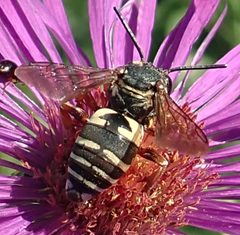
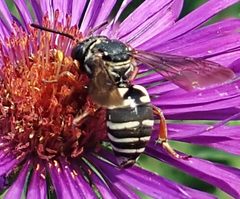
Epeolus autumnalis is a cleptoparasitic cuckoo bee in the Apidae, found in North America. As a member of the Epeolus, it is a nest of polyester bees in the genus Colletes. Like other cuckoo bees, it lacks the branched body hairs typical of pollen-collecting bees and instead relies on bees to provision its offspring. The was described by Robertson in 1902.
Pronunciation
How to pronounce Epeolus autumnalis: /ɛˈpi.o.lus ɔ.tumˈna.lis/
These audio files are automatically generated. While they are not always 100% accurate, they are a good starting point.
Identification
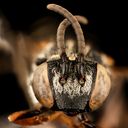
Epeolus autumnalis can be distinguished from other Epeolus by specific morphological features, though detailed diagnostic characters require examination of specimens. Members of the Epeolus generally exhibit short, unbranched hairs forming black, white, red, and yellow patterns, unlike the fuzzy appearance of pollen-collecting bees. The species is smaller than most bees, with body lengths in the genus ranging 5.5–10.0 mm. Positive identification to species level typically requires examination of genitalia and other microscopic features.
Images
Distribution
North America. Specific records include Vermont in the United States. The full extent of its range within North America has not been comprehensively documented.
Host Associations
- Colletes - nest Epeolus are of polyester bees in the Colletes. Females lay in nests, and larvae kill the host egg or larva before consuming the stored pollen provisions.
Ecological Role
As a , Epeolus autumnalis functions as a natural regulator of its bees. Cuckoo bees are typically rarer than their hosts, reflecting the general ecological pattern of and being less abundant than their prey or hosts.
Similar Taxa
- Epeolus attenboroughiAnother North American Epeolus with similar cleptoparasitic and general appearance, though E. attenboroughi is known only from Colorado and New Mexico and has distinct morphological features.
- NomadaAnother of cuckoo bees in the Apidae with similar kleptoparasitic , though Nomada parasitize different bees (primarily Andrena) and can be distinguished by morphological and behavioral differences.
- Epeoloides pilosulusAnother rare North American cuckoo bee, but Epeoloides is specialized on in the Macropis rather than Colletes, and has distinct taxonomic placement within the tribe Epeolini.
More Details
Taxonomic note
Epeolus autumnalis was described by C.H. Robertson in 1902. The Epeolus currently includes 43 recognized in North America, with several new species described in recent years.
Etymology
The specific epithet 'autumnalis' refers to autumn, possibly indicating seasonal activity patterns, though this has not been explicitly documented in the available literature.