
Epeoloides pilosulus
(Cresson, 1878)
Macropis Cuckoo Bee
Epeoloides pilosulus is one of the rarest bees in North America, an obligate kleptoparasite of oil-collecting Macropis bees (Melittidae). It belongs to the tribe Osirini, a group of parasitic bees entirely dependent on oil-collecting bees as . The was thought extinct from the 1950s until its rediscovery in Nova Scotia in 2004, with subsequent records from Alberta, Ontario, Connecticut, Maine, New Hampshire, and Michigan extending its known range. Its survival depends on a three-way ecological relationship: E. pilosulus requires Macropis host bees, which in turn require oil-producing Lysimachia flowers for larval provisioning.
Pronunciation
How to pronounce Epeoloides pilosulus: /ɛˌpe.əˈlɔɪ.diːz ˌpaɪ.loʊˈsuːləs/
These audio files are automatically generated. While they are not always 100% accurate, they are a good starting point.
Identification
The only Osirini in Canada and the United States. Distinguished from other kleptoparasitic bees (e.g., Nomada) by absence of red or yellow abdominal markings, greater and , and presence of Osirini-specific traits: round in cervical and large forewing stigma. Males distinguished by strongly converging and unique pygidial plate surrounded by carinae. Females lack pollen-collecting scopae.
Images
Appearance
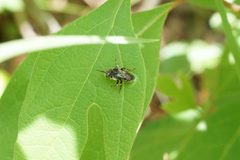
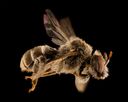
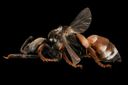
Medium-sized , 7.5–10 mm in length. Entirely shiny black body covered in fine pale hairs, with significantly greater on and than most other Osirini. edges of abdominal have fine bands of dense white hair; no red or yellow abdominal markings. Wings with dusky coloring near margin; forewing with three submarginal , the second significantly smaller than first and third. Marginal cell bends away from wing edge at apex. Females lack scopae (pollen-collecting hairs). Males have large that converge strongly near top of head and a unique pygidial plate nearly surrounded by strong carinae. Round in cervical and large forewing stigma (over three times as long as pre-stigma) are diagnostic Osirini traits.
Habitat
Distribution
North America: historically recorded across eastern and central United States and Canada from Alberta and North Dakota to Maine and Georgia. Canadian records: Alberta (Elk Island National Park, 2018), Saskatchewan, Manitoba, Ontario, Québec, Nova Scotia. United States records: Connecticut (2008), Maine (2016), Michigan (2019), New Hampshire (2019), New York. Rediscovered in Nova Scotia in 2004 after apparent absence of records from 1950s–early 2000s.
Seasonality
active mid-summer, primarily June to July. coincides with Macropis activity period.
Host Associations
- Macropis nuda - primary Principal in Michigan and across range
- Macropis patellata - Recorded as in Michigan
- Lysimachia terrestris - indirect dependencyOil-producing flower required by Macropis ; E. pilosulus females may locate host nests by floral oil scent
Life Cycle
Obligate kleptoparasite. laid in Macropis nests. Larvae kill host egg or larva and consume host-collected pollen provisions. Offspring likely overwinter as fourth or fifth instar larvae before pupating and emerging as in summer. Specific details of stages inferred from better-studied European Epeoloides coecutiens.
Behavior
Kleptoparasitic: does not build nests or collect provisions. Females locate nests, possibly using floral oil scents to find Macropis nests. feed on pollen and nectar from various flowers during active period. Mating occurs during June–July activity period.
Ecological Role
Human Relevance
Subject of conservation concern due to extreme rarity and specialized ecological requirements. Designated Endangered by COSEWIC in 2011; reclassified as Data Deficient in May 2025. Critically Imperiled designation by Xerces Society (2005). Rediscovery records have prompted renewed survey efforts and conservation attention. Serves as for intact wetland supporting oil- mutualisms.
Similar Taxa
- NomadaOther kleptoparasitic bees in Apidae; distinguished by E. pilosulus having no red or yellow abdominal markings, greater , and Osirini-specific wing and cervical traits
- Epeoloides coecutiensEuropean ; details often inferred from this better-studied , but E. pilosulus is the only North American Epeoloides species
Misconceptions
Thought to be extinct from 1950s until 2004 rediscovery; subsequent records demonstrate persistence but extreme rarity. Presence of Lysimachia flowers alone does not indicate E. pilosulus presence, as both Macropis and the cuckoo bee have more specific requirements.
More Details
Conservation status changes
COSEWIC status changed from Endangered (2011) to Data Deficient (May 2025) due to new records expanding known range, though remains extremely rare with sparse observations
Taxonomic history
Originally described as Nomada pilosula by Cresson in 1878 from a single New York specimen; transferred to Epeoloides by Ducke in 1909
Collection rarity
Only 12 specimens recorded from Canada up to 2011; rediscoveries since 2004 represent significant range extensions rather than recovery
Sources and further reading
- BugGuide
- Wikipedia
- GBIF taxonomy match
- iNaturalist taxon
- Catalogue of Life
- conservation | Blog - Part 13
- pollinators | Blog - Part 2
- entomology | Blog - Part 10
- Epeoloides pilosulus (Cresson) Rediscovered in Michigan, with Notes on the Distribution and Status of its Macropis hosts.
- A new western Canadian record of Epeoloides pilosulus (Cresson), with discussion of ecological associations, distribution and conservation status in Canada
- Figure 1 from: Sheffield C, Heron J (2018) A new western Canadian record of Epeoloides pilosulus (Cresson), with discussion of ecological associations, distribution and conservation status in Canada. Biodiversity Data Journal 6: e22837. https://doi.org/10.3897/BDJ.6.e22837
- Figure 7 from: Sheffield C, Heron J (2018) A new western Canadian record of Epeoloides pilosulus (Cresson), with discussion of ecological associations, distribution and conservation status in Canada. Biodiversity Data Journal 6: e22837. https://doi.org/10.3897/BDJ.6.e22837
- Figure 4 from: Sheffield C, Heron J (2018) A new western Canadian record of Epeoloides pilosulus (Cresson), with discussion of ecological associations, distribution and conservation status in Canada. Biodiversity Data Journal 6: e22837. https://doi.org/10.3897/BDJ.6.e22837
- Figure 3 from: Sheffield C, Heron J (2018) A new western Canadian record of Epeoloides pilosulus (Cresson), with discussion of ecological associations, distribution and conservation status in Canada. Biodiversity Data Journal 6: e22837. https://doi.org/10.3897/BDJ.6.e22837
- Figure 6b from: Sheffield C, Heron J (2018) A new western Canadian record of Epeoloides pilosulus (Cresson), with discussion of ecological associations, distribution and conservation status in Canada. Biodiversity Data Journal 6: e22837. https://doi.org/10.3897/BDJ.6.e22837
- Figure 2 from: Sheffield C, Heron J (2018) A new western Canadian record of Epeoloides pilosulus (Cresson), with discussion of ecological associations, distribution and conservation status in Canada. Biodiversity Data Journal 6: e22837. https://doi.org/10.3897/BDJ.6.e22837
- Supplementary material 2 from: Sheffield C, Heron J (2018) A new western Canadian record of Epeoloides pilosulus (Cresson), with discussion of ecological associations, distribution and conservation status in Canada. Biodiversity Data Journal 6: e22837. https://doi.org/10.3897/BDJ.6.e22837
- Supplementary material 1 from: Sheffield C, Heron J (2018) A new western Canadian record of Epeoloides pilosulus (Cresson), with discussion of ecological associations, distribution and conservation status in Canada. Biodiversity Data Journal 6: e22837. https://doi.org/10.3897/BDJ.6.e22837
- Figure 6a from: Sheffield C, Heron J (2018) A new western Canadian record of Epeoloides pilosulus (Cresson), with discussion of ecological associations, distribution and conservation status in Canada. Biodiversity Data Journal 6: e22837. https://doi.org/10.3897/BDJ.6.e22837
- Figure 5 from: Sheffield C, Heron J (2018) A new western Canadian record of Epeoloides pilosulus (Cresson), with discussion of ecological associations, distribution and conservation status in Canada. Biodiversity Data Journal 6: e22837. https://doi.org/10.3897/BDJ.6.e22837